Saturday, February 24, 2018

In Case You Needed A Reminder, Globalist Corporations Are Not Our Allies


That pretty much captures it. Companies like Metlife, Hertz and Enterprise are severing their relationship with the National Rifle Association and essentially daring the membership of the NRA to do anything about it. Since conservatives are terrible at this I am guessing not much will happen. It is like corporations pandering to homosexuals, the risk of offending normal people who don't do business ideologically is pretty slim so we get to see dudes pawing each other in commercials to appeal to the tiny fraction of people that are homosexual in this country. The same is true here. There are over 5 million active NRA members and millions of other Americans that are not dues paying but might as well be. I recently renewed my membership which had been lapsed for years but I pretty much voted 100% in line with the NRA and followed their news posts even when I wasn't paying dues. Regardless the profit calculation says risking offending millions of consumers is less dangerous than some bad P.R.. They are probably right.

This is how the "alliance" between the big globalist corporate world and middle American religious conservatives go. We show up in droves to the polls to elect Republicans on the promise of getting things that are important to us like restrictions on abortion, conservative judges and immigration enforcement. When the Republicans get power, we don't get much or any of that (sometimes the judges because they also rule in favor of corporations). What we mostly get is a condescending pat on the head and excuses.


Of course we get super important tax cuts for the corporations and lots of deregulation, all of which is good and I support wholeheartedly but it isn't exactly like the rank and file are getting equal value for showing up by the millions and we often get lied to and betrayed as part of the bargain.

Enough.

Corporate America is not our ally. They will and regularly do sell us down the river at the first whiff of controversy, because taking risks and bad publicity of any sort is bad for profits. That is fine, I understand that. I just don't want to pretend that we are after the same thing. I would gladly support trade barriers in return for eliminating abortion and I won't abandon 2nd Amendment rights no matter how much it might make the 401(k)s in this country grow. Ultimately globalist corporations are not cowardly but they are at best amoral. They don't care who buys their goods and services. A credit card swiped by a homosexual couple is just as good as one from a normal married couple. An illegal alien buying a phone is no different to Apple than someone with a family that goes back to the Pilgrims. As long as they are hitting their quarterly targets nothing else matters. For people like me? I am concerned about the future of this country that I leave for my children and future generations. I care about the survival of Western civilization that in spite of many flaws is still the greatest force for good in world history. That means that next quarter's profits are not as important as long term trends that are transforming our nation. A 10% annual return in my IRA portfolio is meaningless compared to the lives of the unborn. My right to keep and bear arms is not for sale.

I have been on this trajectory for a while. The Republican Party has wasted my vote for too many election cycles. There needs to be a serious alternative to the mainstream conservatism that is owned by the corporations and the warmongering neo-cons. Maybe that is the Constitution Party. Maybe something that doesn't exist yet. I think the latter is more likely and I will be writing more about that soon. All I know is that the GOP cares more about what is good for the U.S. Chamber of Commerce than it is in what I and tens of millions of actual conservatives care about and I am pretty much done with it. Conservatives are suffering from Stockholm Syndrome with the Republican party. We are convinced that in spite of our captivity and the abuse we suffer that the GOP really does love us deep down. In many ways we are the mirror image of blacks and the Democrats. Dems haven't given a fig about blacks for a long time and they don't really pretend to other than giving them the same empty promises and pats on the head that conservatives get from the GOP. Starting a new movement takes an enormous amount of energy but I think there is a ton of energy out there untapped, weary after decades of being lied to and having lame empty suits or outright sociopaths like Mitt Romney and John McCain foisted on us, but ready to get fired up for the right movement. Trump tapped into that and he won even though we have been told for decades that the GOP has to embrace unlimited immigration to survive.

It is time to wake up people. It is time to name names and find out who is really on our side and who just gives us pats on the head.

Making a quarrel of every dispute

I have a strong belief that there is a danger of the public opinion of this country … believing that it is our duty to take everything we can, to fight everybody, and to make a quarrel of every dispute. That seems to me a very dangerous doctrine, not merely because it might incite other nations against us … but there is a more serious danger, that is lest we overtax our strength. However strong you may be, whether you are a man or a nation, there is a point beyond which your strength will not go. It is madness; it ends in ruin if you allow yourself to pass beyond it.
—LORD SALISBURY, 1897
The Queen’s Speech
Buchanan, Patrick J. (2008-05-26T23:58:59). Churchill, Hitler, and "The Unnecessary War": How Britain Lost Its Empire and the West Lost the World (Kindle Locations 59-66). Crown/Archetype. Kindle Edition. 

These words from the era just before World War I from an empire that  would soon diminish significantly should be a warning to those of us in the new empire that seem to think we can go looking for a fight all around the globe and never suffer for it. The United States does not have limitless strength and resources and I fear we are at the breaking point, or perhaps beyond it without even realizing it.

Book Review: Adios, America


While at times hard to read, Ann Coulter's 2015 bestseller Adios, America! is a powerful and thoroughly researched look at the immigration issue in America from a hardline position. Ann is in many ways the embodiment of Campaign Trump, not to be confused with President Trump. She daily posts a mocking tweet on the lack of progress on the border wall:

No one is going to be confused as to where she stands on the question of immigration but even if you don't agree with her, her research ought to give you pause.

Ann Coulter does her level best to make herself someone you dislike and someone you dislike is someone that is easy to ignore. She is sarcastic almost to a fault, said as someone who is pretty sarcastic, and sometimes says things that are so acerbic as to make even a hardened reader cringe. It is her schitick and I get it but it also means that it can be easy to not take her seriously. This book, even with the over-the-top title and subtitle ("The Left's Plan to Turn Our Country into a Third World Hellhole") absolutely demands to be taken seriously because the topic it covers is so very important.

The number one problem with this book is that it came out in June of 2015. It came out before Trump announced and therefore it looked for all the world like the Republican nominee was going to be just another empty suit, pro-amnesty at the bidding of the U.S. Chamber of Commerce GOP-bot. Things have changed in this country since 2016 but there is still a lot of concern that mirrors what Ann is writing about.

For Coulter in this book, immigration is everything and she rightly recognizes an inconvenient truth: Democrats only care about immigration for one reason....
The reason Democrats support immigration is because of how they vote.
Coulter, Ann. Adios, America: The Left's Plan to Turn Our Country into a Third World Hellhole (Kindle Locations 174-175). Regnery Publishing. Kindle Edition.
Democrats only care about the children of lawbreakers when it will get them 30 million new voters. Convicted felons are next.
Coulter, Ann. Adios, America: The Left's Plan to Turn Our Country into a Third World Hellhole (Kindle Locations 187-188). Regnery Publishing. Kindle Edition.
That is the core of the immigration debate from legal immigrants to illegal aliens to amnesty for "Dreamers". It is all about electoral math. Democrats have abandoned the White vote and are relying mostly on minorities and immigrants to propel them to victory in the future. The GOP doesn't seem to get this but for Coulter every single other issue is secondary to immigration because once there are sufficient "new Americans" to reliably vote Democrat, states like Texas and Florida will become like California and never vote Republican again. That means no tax reform, no protection of 2nd Amendment rights, no conservative justices, no restrictions on abortion or the demands of the militant homosexual movement, no restraint on spending or the welfare state or job killing bureaucratic regulations. Lose on the immigration issue and you lose everything....
What happens with immigration will determine whether America continues to exist or becomes a Third World republic that will never elect another Republican—in other words, “California.” It’s more important than gun rights, right to life, taxes, or Iran’s nuclear program—or whatever other issue you care to cite, because immigration will decide all issues, once and for all, in favor of the Democrats.
Coulter, Ann. Adios, America: The Left's Plan to Turn Our Country into a Third World Hellhole (Kindle Locations 4711-4715). Regnery Publishing. Kindle Edition. 
It does seem a little callous to reduce people to electoral math but that is the reality of the immigration debate.

From liberal activists seeking new voters to rich Republicans that want cheap lawn care and nannies, there is a powerful cabal of people that want virtually limitless immigration. The Left needs new voters and the wealthy aren't impacted by mass immigration so we see what should be a weird alliance between Republican elites and far left loons. Left out of the equation are regular working Americans, especially minorities and low income workers that are displaced by an endless flow of workers that will do the same job for less and that turn around and send their wages out of the country, a massive outflow of at least $20 billion a year that in turn enriches the wealthiest in Mexico, like Carlos Slim, who in turn are incredibly influential over U.S. media sources like the New York Times. It seems odd but the only people that seem to care about the displaced workers in America are people like Ann Coulter. While "conservatives" like Bill Kristol casually advocate for the wholesale replacement of the current American workforce, people like Ann are not willing to go down without a fight. Perhaps it will be in vain, it probably will be, but at least some of us are trying and Ann, for all of her sometimes unpleasant rhetoric, is one of them.

Wednesday, February 21, 2018

In Praise Of Imperfect Theology: Remembering Billy Graham

The big news of the day across even most of the secular press is the death of evangelist Billy Graham. Almost immediately the praise started flowing in, some over the top, but most celebrating the life of this most well known of evangelicals and rejoicing in his joining with Christ in glory. When a famous person dies they are often immediately trumpeted into the Kingdom even when every bit of evidence would show them to be an unbeliever. It is nice today to have someone pass on that I am as sure as I can be about any famous person is now in a "better place".


On the other hand some people took the occasion of his death as an opportunity to criticize Billy Graham.

As I consider myself to be an armchair theologian, it seems appropriate to point out that with the passing of Billy Graham I had some criticisms of him when he was alive as well. If I had ever had the opportunity to sit down over coffee with Billy and talk theology, I bet we would have had some pretty heated arguments.

I criticized Graham for meeting with Mitt Romney and the removal of mormonism from the list of cults at his ministry webpage. I criticized Billy Graham for saying that any criticism of your pastor is a sin. I think he was a little too chummy with politicians. I strongly disliked the way his name was used as a marketing tool or as a way to add false credibility for men like Tullian and Boz Tchividjian.

I was critical of his Arminianism as I was for many other famous preachers who preach to large crowds with altar calls and sometimes overly emotional appeals. I find revivalism to be a bit too close to manipulation for my taste and I am certain that a significant, perhaps overwhelming, percentage of those who "made decisions" at his crusades over the years were in fact not regenerate and likely walked away from the faith they never had once the emotional high wore off.

On the other hand...

There are no theologians alive or dead with perfect theology. Some great ones have had some pretty deeply flawed theology ( looking at you Martin Luther). The only person is agree with 100% of the time is the bearded guy in the mirror and sometimes I am not so sure about him.

Billy Graham may have had some problems with his theology but my criticisms of him were as a brother speaking to a brother. As I was looking back over my search for his name on my blog I ran across a post from 2010 where I quoted Frank Turk, who made a great statement about Billy Graham that I recalled today:
With Augustine, I’d object strongly to his view of his the eucharist; with Aquinas, I’d object to his Platonism aristotelianism (thx, Bobby) and his extra-biblical musings; Calvin wants to baptize babies, and ultimately advocates for Presbyterian ecclesiology; Jerome was, well, Jerome – a monastic with a high view of Mary and a low view of marriage; Wesley – Arminianism; Billy Sunday & Billy Graham & Chuck Colson – the manner and mode of Ecumenism, up to and including a tacit disregard for the still-evident distinctions between Protestants and Catholics.
But here’s the thing: I think we are compelled to call all of these men Christians -- and I’m not speaking in some broad sociological sense, either. Some of them may be bad Christians – doctrinally bumfuzzled or worse: doctrinally indifferent. Some of them may be misguided – as I think Aquinas was – for intellectual or sociological reasons. But they are Christians.
Amen to that. I love John Calvin but if I were to have taught in Geneva some of the things I believe the Bible teaches about baptism and the church when he was there, I might have shared the fate of Servetus. I love John MacArthur but I think he is way off on dispensationalism. I wish John Piper would steer clear of some of the racial virtue signaling. R.C. Sproul was flat out wrong about "infant baptism". Mark Dever has a number of serious flaws in his ecclesiology which are part of the 9 Marks ministry teaching on the church. My brothers in the Church of Christ are likewise deeply wrong on baptism but I still consider them brothers even when some of them would say I am not their brother because I disagree with their understand and application of baptism. Most Christians I have known personally throughout the year were caught up in Arminianism, were theologically disinterested and clung to the institutional mode of the church that kept them spiritual infants.

Billy Graham could be accused on being willing to go too far to make a disciple to the point of making false disciples, although I am sure not intentionally. He also did more in a year of his life to reach the lost and make much of Jesus Christ than most pastors, theologians and social media geniuses do in their lifetime. He probably did more to reach the lost with the name of Jesus on a decent afternoon than I ever have. I am certain that many, many people were reached for Jesus and came to saving faith through the regenerating power of the Holy Spirit under the preaching of the Word by Billy Graham because I believe God sovereignly uses flawed theologians and pastors and evangelists. Good thing he does because being flawed is one thing everyone from Paul and Peter to Calvin and Luther to Piper and Mohler to Billy Graham and me have in common. 

So today is a day to remember a man who committed his life to the Gospel in his own weak and inadequate way. Some day soon he will hear these words all believers long to hear: ‘Well done, good and faithful servant. You have been faithful over a little; I will set you over much. Enter into the joy of your master.’. Well done brother. I look forward to seeing you again in glory.

Monday, February 12, 2018

How Many Churches Will Egalitarianism Claim?

Albert Mohler penned an essay today looking at the new "Illumination Project" report out of the Cooperative Baptist Fellowship, the splinter group formed in response to the Southern Baptist "Conservative Resurgence". His essay, All Other Ground is Sinking Sand: A Portrait of Theological Disaster, is a good history lesson, although one must keep in mind that there is a partisanship about it given that Dr. Mohler was one of the pivotal figures in the Conservative Resurgence and remains one of the steadfast proponents of biblical authority in the SBC.

Mohler's essay reminds us yet again of a simple truth: there is a fork in the theological road that all denominations and local churches must eventually choose, whether to call women as elders (or ordain  them as pastors to use the institutional language). When one chooses to ignore the teaching of Scripture and call women into positions of authoritative leadership in the church there is a nigh inevitable downgrade that follows. As Mohler wrote:
This is also the logical consequence of adopting a hermeneutic that allows for the service of women as pastors — for many CBF congregations, the key issue of outrage at the SBC. The same negotiation and “reinterpretation” of the biblical text that allows for the service of women pastors will logically lead to the acceptance of the LGBT revolution. How can it not? Individuals and congregations may refuse to take this next step, but they have surrendered the only binding argument that would offer an objective truth claim. Eventually, the revolutionaries will win, and they know it. Clearly, some appear unwilling to wait.
I am not aware of an example where a denomination chose to call women as elders while remaining faithful to Scripture in other places over the long term. There is no path where women elders and orthodoxy walk hand in hand. This is the inevitable result of practical egalitarianism...


Two "married" lesbian "Senior Ministers and Co-Pastors", the "reverend" Maria Swearingen and the "reverend" Sally Sarratt who head up Calvary Baptist Church in Washington, D.C., an "ecumenical, multi-racial, multi-ethnic Christian body". The "co-pastors" wrote a screed in response to the "Illumination Project" report, where they express anger and not without reason for the CBF's schizophrenic treatment of homosexual sin, allowing open homosexuals to be hired for some positions but not for others. Their open letter includes the obligatory MLK quote, langauge about "colonialism", "violence" (Scriptural faithfulness is now violence apparently), "imperialism" and the "exportation of violent theology all over the world in service to Empire". Mixed in with a grab-bag of "progressive" nonsense is am ominous statement from these "co-pastors" (emphasis in original).
First, while all people may be equal, all opinions are not equal, nor should they be given an equal place at the table. This is a morally debilitating myth we keep telling each other to pacify conflicts and coddle our fears over disagreement and loss. Jesus did not think all opinions were equal. Jesus’ witness and example demonstrates that the opinions, better yet the lives, of the dispossessed were worthy of more time and attention than calculating mathematically equal air-time for everyone. The fact that we think decision-making in light of the gospel of liberation should look like “equally valid opinions getting equal time” is not only absurd, it is a striking example of the “banality of evil,” as Hannah Arendt describes it.
Read that again. Behind the "progressive" language of tolerance and the nice smiles of the two lesbian "pastors" there is a far more insidious message here, one I have run into personally on social media. All people may be equal (and then again they may not) but not all of their opinions are equal. To paraphrase the warning words of George Orwell, all animals are equal but some are more equal than others. In other words, these women have decreed that some opinions are just not worthy of being held and are not worth being considered. Someone with a firmly held belief, as the church has held for 2000 years, that homosexual behavior is incompatible with full inclusion in the Christian community, much less leadership, is not only mistaken but they are not even worthy of being heard. This is a sinister belief. I have been told online that because of who I am, my opinions are automatically invalid and unworthy of being heard, regardless of the merit of what I am saying. Here we sit in 2018 and a couple of women who fancy themselves married and elders have declared that the essentially unanimous position of the greatest pastors and theologians of the church for 2000 years, from Paul and Christ Himself to present day, are null and void and are not even deserving of being given "equal time". It is pretty easy to win an argument when you don't allow your opponent to speak at all.


This is the state of the "progressive" church.
It is anti-Scriptural, anti-intellectual, illiberal and authoritarian in the extreme. Ultimately it is anti-gospel and in the spirit of anti-Christ.
Is it "progress" that debates over the application of Scripture are closed down without even so much as consideration? I am glad to discuss any topic with any person with an open Bible because I am confident in my positions and hopefully humble enough to be corrected by Scripture where I am wrong. The oxymoronic phrase "progressive Christianity" is just code for a religious veneer of respectability slapped over old fashioned authoritarian thought policing. Maria Swearingen and Sally Sarratt are representative of the totalitarian progressive impulse to push an agenda by shutting down conversation and attempting to control speech and thought itself.

Like the mass media shedding the last vestige of impartiality and journalistic integrity in the Trump era, the "progressive" religious authoritarians have given up even pretending to engage in Scripture, however clumsily, and have openly resorted to demanding that certain opinions, no matter how Scripturally supported and historically grounded they may be, be considered Thoughtcrime. It is high time we stop pretending these are wayward members of the church and start to call them what they are: heretics and false prophets, wolves among the sheep. What Maria Swearingen and Sally Sarratt and Rachel Held Evans and the majority of the mainline denominations and even apparently in a clumsy sense the Cooperative Baptist Fellowship are championing is not a variation of Christianity, a mistaken but sincere expression of the faith, but another "gospel" entirely where sin is celebrated and faithfulness is silenced.

Tuesday, January 23, 2018

Imprisoned For Sixteen Years For The Faith

Check out this video from James White, filmed while visiting the hole that Fritz Erbe, a 16th century Anabaptist who was, like so many others, imprisoned and tortured for the "crime" of refusing to baptize his children, was held by ostensibly "Protestant" men. What a cruel place to be imprisoned and what great faith he must have had to hold fast to the Scriptures in the face of such cruel torture because of his holding firm on a subject we consider today to be of secondary importance. There are men who say in error that water baptism saves us and those who, also in error, think that a days old infant incapable of professing faith should be baptized. On the one hand it is a sign of some maturity in the church that we don't put one another to death over these issues anymore but on the other it makes me wonder just how firmly we hold to any position in the church. Think about being lowered into that hole with no hope of escape and ask yourself just how strong your convictions truly are.

Sunday, January 21, 2018

On This Day In Church History: The First Anabaptist Baptism

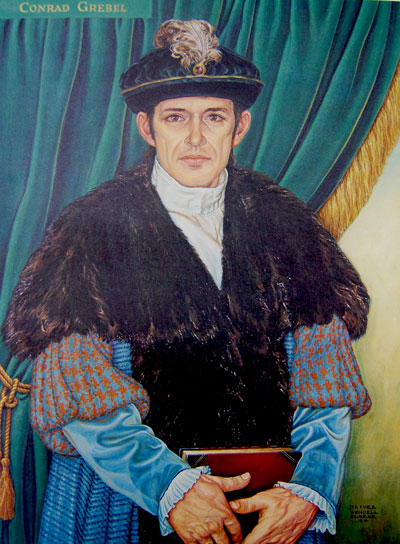
On January 21st, 1525 Conrad Grebel baptized George Blaurock. Blaurock then baptized the other men present including Felix Manz and Grebel. This followed the disputation in Zurich where Zwingli disputed with Grebel and Manz over the subject of baptism. Although Zwingli was unsurprisingly declared the victor in support of "infant baptism", the brethren still chose to be baptized a few days later. This would start them on a path that would lead many Anabaptists to being murdered by the hands of the state at the urging of the religious authorities.

You might wonder why you should care if you are not part of an Anabaptist heritage group like the Amish, Mennonites or Hutterites. If you are someone who cares about religious liberty, this is a critical moment in the church when a handful of men risked their lives to take the rite of baptism out of state hands. The religious liberty we cherish and that is enshrined in our Constitution can be traced in part back to this courageous act of defiance almost 500 years ago. May God raise up more men in this day with the courage to stand fast on the Word of God against those who would seek to pervert it or use it to gain worldly power.

Saturday, January 20, 2018

Are Reformed Christians Influenced By White Supremacy?

Desiring God, the online ministry of John Piper, is one of my "go to" sources on many topics. Some of the material published there is among the highest quality material for the Reformed Christian available on the net. For example, last Sunday they published Before You Believed, You Belonged which is one of the best things I have read ever. But then the very next day they publish something that I remarked to a friend was "terrible" and "counter-productive". The offending essay comes with the click-bait title: Providence Is No Excuse: Exposing a Reformed White Supremacist by Daniel Kleven, who is the director of admissions for Bethlehem College and Seminary where John Piper is chancellor.

In the pantheon of terms that are a) way overused and applied and b) are completely misunderstood, "white supremacy" is near the top of the list. I am not sure I can name an actual white supremacist today. Even well known people like David Duke and Richard Spencer are more properly considered white nationalists than they are white supremacists, in the same way that someone like Louis Farrakhan is a black nationalist advocating in part for distinct, racially homogeneous nations. People like Richard Spencer don't want to rule over non-whites, i.e. white supremacy, they want to live apart from non-whites. A subtle difference perhaps but an important one to understand in a climate where the term "white supremacy" is used to label almost anyone that doesn't completely adhere to the edicts of the racism-industrial complex.

Who was this White Supremacist that Daniel Kleven "exposed"? His name is Robert Lewis Dabney, a 19th century Southern American pastor and theologian. He was also a chaplain in the Confederate Army, a biographer of Stonewall Jackson and was a supporter of slavery even after the end of the Civil War. In addition to his biography of General Jackson, in 1867 he wrote a book with a lengthy title characteristic of that time, A Defense of Virginia, and Through Her, of the South, in Recent and Pending Contests Against the Sectional Party, as well as a number of theological tomes. You can be forgiven if in 2018 you haven't heard of Dabney or if you have, you have heard of him only in passing or via a one line quote in the writing of someone else. After all the man lived and died in the 19th century.

Why did Daniel Kleven choose to bring up Dabney? Is Dabney a particularly influential Reformed thinker? As someone who has been engaged in Reformed theology for many years, I know the name but he isn't someone I consider influential or even someone that I ever recall reading anything from. I have seen his name crop up here and there from time to time.

At Monergism, the gold standard for Reformed theology, there is a section where you can look up articles by the author. Some are obviously huge, John Calvin has almost 400 results. What about Dabney? He shows up 24 times. Compare that to someone like Francis Turretin, a fairly obscure reformed theologian with over 60 results, not to mention men like Charles Hodge with 90 results and Charles Spurgeon with over 1,200 results. Compared to modern Reformed writers like John Piper and R.C. Sproul, Dabney is barely a blip on the radar. If you were to poll people at a Reformed conference like Together for the Gospel and ask how many of them knew who Dabney was, I think few would know much more than his name. Asked how many had read anything of his and I am confident you would get a much, much smaller positive response. He just isn't a top-tier or even mid-tier theologian among the contemporary Reformed.

Even Doug Wilson, who endlessly finds himself forced to defend against (unwarranted) accusations of racism and being a slavery apologist and is one of the few people to regularly quote Dabney, describes Dabney as an "irascible slave owner". No one who knows much about him fails to understand that Dabney was a man of the 19th century with all that entails.

Yet he is referred to in this article as a champion of Reformed theology: "It’s hard to look racism in the face, especially when that face is one of a champion of Reformed orthodoxy". A champion?

Notice this introduction from Kleven's article and please note my emphasis:
In his time, Robert Lewis Dabney (1820–1898) was considered one of the greatest teachers of theology in the United States. Revered theologians such as Hodge, Shedd, Warfield, Bavinck, and Barth viewed him with appreciation and respect.
In the 19th century, he was considered one of the greatest teachers of theology. Other more widely known Reformed theologians, now long dead, "appreciated" and "respected" Dabney. So he had some influence over other theologians 100 years ago.

So I ask again, why did Daniel Kleven choose Robert Dabney to make the case that somehow contemporary Reformed types have a White supremacist skeleton in their collective closet? My only conclusion can be that Daniel wanted to write an article on this topic and went searching for someone, however obscure, to fit the bill. Unlike Hodge or Warfield, Edwards or Spurgeon, Dabney wrote some stuff that makes good fodder for this sort of article. It is an editorial form of eisegesis, predeterming that there are "Echoes in Our Day" of White supremacy. Of course the church has already condemned pro-slavery positions and the institution itself in unequivocal terms. For example, the Presbyterian Church in America (PCA) has a historically valuable e-book on their historical website written by Thomas Cary Johnson that has this caveat:
Please note that this history is posted solely for its value as a historical document. Any statements in Johnson's book in support of the institution of slavery or in support of racial supremacy should be clearly and obviously understood to be rejected by the Presbyterian Church in America, by the PCA Historical Center, and by the Center's director. The book is posted here that we might learn from it as history, and that we might learn too from its errors, as well as its truths. It should continue to amaze us that highly valued leaders in the Church can be so very wrong about some matters while still holding to vital truths about the Christian faith. May God grant us the ability to see and repent from the sins we ourselves are blinded to by our own culture today.
It is pretty clear to anyone paying attention that the issue of slavery and "racial supremacy" has been condemned by the church, including the Reformed church. I don't know of any even semi-serious Reformed writers that promote racial supremacy or hold a pro-slavery view.

Dabney was a product of his times and while it is easy to cluck our tongues disapprovingly at what he wrote 150 years ago, it is not very useful. I am sure without bothering to look that there were men all across the religious (and non-religious) spectrum in the era leading up to and immediately after the Civil War that used language similar to, if not worse, than what Dabney did. Slavery was the law of the land and slavery, as we see in the Bible and elsewhere, has been practiced by humanity for thousands of years, by whites and blacks, Christians and Muslims. Men like Dabney can be brilliant theologians and still be terribly wrong on some issues and it doesn't diminish their value. Calvin made a horrendous error in his complicity with the execution of the heretical Servetus. Martin Luther made statements considered by some to be anti-semitic. Men are flawed, something that Reformed Christians understand perhaps better than others, and it certainly isn't necessary to put an addendum next to any quote from Calvin that he was complicit in the state execution of Servetus.

Mr. Kleven concludes his essay with the obligatory homage to Martin Luther King, Jr.
A true understanding of providence should lead us to act the miracle of change in pursuing justice.
Martin Luther King came closer to this in regard to racial justice than did Robert Lewis Dabney.
As impolite as it may be to point out, King was in many ways a deeply heterodox religious figure, someone who held positions that if they were held by someone other than a slain Civil Rights icon would be condemned by most orthodox Christians. Not to mention that King's personal life, including very credible evidence of serial adultery, brings into question whether he knew Christ at all.

What exactly was Kleven's point? Slavery and support for slavery was bad? Did we really need another essay about that? Or was this just an obligatory essay to mark MLK day?

So why was this essay terrible and counter-productive? It was terrible in that it presents a fairly esoteric figure in Reformed theology as a means to taint all Reformed Christians with the guilt of white supremacy and it fails to recognize the very real lack of white supremacist thought in contemporary times anywhere in America, much less in evangelicalism, even less so in Reformed circles. It is counter-productive because the essay itself is an exercise in virtue signaling, a term I recognize is overused but appropriate I believe in this case. The comments on Facebook that accompanied the original posting from Desiring God, including mine, exhibited that most people were not buying into this idea of white supremacy lurking just below the surface of Reformed Christianity based on one example of a man who live and died in the 19th century South. As someone who thinks and writes and tries to take seriously the question of race in the church and America in general, I found the essay far from enlightening and more accurately simply another example of clumsy guilt-tripping that accomplishes little but to make the author feel that he has somehow struck a blow for racial justice.

Self-flagellation over alleged racial guilt is the neo-Reformed version of the #MeToo farce, just in reverse. Instead of feeling left out because you weren't a victim, many feel left out that they have never actually oppressed anyone so they create some linkage from themselves to oppression, no matter how tenuous.

Those into racial guilt virtue signaling BDSM don't want to really have to ask hard questions and get into uncomfortable conversations. They simply want a sharp rap on the bum with a riding crop from Mr. Grey, leaving no lasting impact but giving that sense of feeling like you have been duly chastised for your latent racism and are now cleansed and in a position to scold others.

Essays like Daniel Kleven's are theological cotton candy, brightly colored but empty of any substance. It is a throwaway piece, generating a little heat but no light and just as quickly forgotten as it was read. Worse it deflects serious questions about race relations and even issues like the providence of God as it pertains to slavery in favor of vacuous references to relatively obscure figures in the church and breathless warnings about "white supremacy". Desiring God is a resource that often provides deep, meaningful, thought-provoking materials and it could do the same on questions of race. Instead we got a Huffington Post religion page level discourse. No topic in the church today is in greater need of clarity and soberness than race but all too often what we get instead are essays like Daniel Kleven's. I have come to expect better from Desiring God and I was deeply disappointed. Serious topics demand serious scholarship.

Tuesday, January 16, 2018

Occultism In A Methodist "Church" With Nary A Whimper From The UMC

A video was posted a few days ago that featured a Black Lives Matter speaker, Melina Abdullah, leading what can only be described as a séance in what is ostensibly a Christian church during a meeting aimed at raising support to stop the construction of two new jails in Los Angeles. The Daily Wire reports on what took place.
Dr. Melina Abdullah — a professor at California State University who also leads the Los Angeles chapter of Black Lives Matter — recently summoned the spirits of several deceased people to fill a Methodist church with ethereal energy, including Martin Luther King, several other slain civil rights leaders, victims of police brutality, and an African warrior named Shaka Zulu.
“This is not just a social justice, a racial justice, an economic justice struggle,” Abdullah told a crowd gathered at Hollywood United Methodist Church on Thursday night. “This is also a spiritual struggle, so it’s appropriate that we’re here in this setting. It’s also important that we summon the right energy into this space no matter what faith you are.”
The church was hosting a townhall organized to stop two new jails from being built in Los Angeles County. The meeting opened with Abdullah leading a ritual called the “pouring of libations,” which she defined as “a summoning of energy” in “the names of our ancestors.”
You can watch a portion for yourself, at least until the censors at YouTube take the video down. I have watched it and it does indeed contain what is described by the article.


Of note is the chant "Ase" after each name is uttered. Ase is a concept of animistic, pagan West African religion described as follows from Wikipedia:
Ase (or às̩e̩ or ashe) is a West African philosophical concept through which the Yoruba of Nigeria conceive the power to make things happen and produce change. It is given by Olodumare to everything — gods, ancestors, spirits, humans, animals, plants, rocks, rivers, and voiced words such as songs, prayers, praises, curses, or even everyday conversation. Existence, according to Yoruba thought, is dependent upon it.
In addition to its sacred characteristics, ase also has important social ramifications, reflected in its translation as "power, authority, command." A person who, through training, experience, and initiation, learns how to use the essential life force of things to willfully effect change is called an alaase.
Rituals to invoke divine forces reflect this same concern for the autonomous ase of particular entities. The recognition of the uniqueness and autonomy of the ase of persons and gods is what structures society and its relationship with the other-world.
If you think that sounds like a pagan, occultic practice and concept, you are correct. If you further think that the Bible condemns this sort of thing, you are also right. If you wonder why a "church" would agree to this going on, assuming someone from the church was there, you are on the right path.

It sounds as if this was a community event hosted by the church, not an actual "official" church gathering but on the other hand the "church" hosting this event, Hollywood United Methodist Church, proudly proclaims their "progressive" street cred in search results....


...and a "leadership team" features the obligatory female "senior pastor" and an open, "married" homosexual "associate pastor" as well as a couple of other homosexual staff...and a statement of "beliefs" that includes gems like this:
We believe in the Bible, interpreted through the lenses of our reason, experience and tradition, and wherever it agrees with the fundamental truth of God’s love and grace as revealed by the life of Christ.
Well that is just a deliciously nonsensical example of circular reasoning "We believe the Bible where the Bible agrees with Jesus!". Of course all we know about Jesus we get from the Bible so what this really means is that this "church" pre-determines which parts of the Bible they will agree with rather than being conformed to what the Bible says. Little wonder they have a woman senior pastor, practicing homosexuals on staff and host far left wing political events that feature a blasphemous séance and involving of an animistic religious practice. If I was a senior pastor and I heard about this going on in our building I would stop it. Or if I was a member. Or if I was a regular attender. Or if I was someone just wandering down the street and heard/saw a women pouring out libations, trying to summon the spirits of dead people and invoking animistic chanting.

I am not surprised to see stuff like this happening at a "church" but I do have to wonder what in the world is going on at the United Methodist Church headquarters that no one, as far as I can tell, has made a peep about something that has as much business being done in a building consecrated to the Christian faith as a goat being sacrificed to Demogorgon.

My real question is this. I know people that are in UMC churches that seem like pretty solid Christians that don't buy into this nonsense but yet are allowing themselves to be unequally yoked with unbelievers (2 Corinthians 6:14-18) that preach and practice rank heresy. When you are part of a church that is part of a denomination, you express some level of unity and solidarity with other churches in that denomination. If I became a member of a Southern Baptist church, I would understand that implies some unity on essential doctrines with every other Southern Baptist church. At what point do faithful Christians in United Methodist churches demand some action from the denomination to deal with wayward local churches or push their own local church to leave the denomination or failing that find some other church to attend?

I understand the power of history and tradition and loyalty but at some point you have to ask if you can be in fellowship, even from a distance, with a local church that allows an unbeliever to have a séance invoking the spirits of a Zulu pagan warlord and a Muslim Black Nationalist into a Christian church. Is the United Methodist Church so desperate to be seen as tolerant and inclusive that they will gut every single feature of the faith in order to appease the ever shifting sensibilities of the unbelieving world? I think recent history unfortunately assumes that they are.

Saturday, January 13, 2018

Are We In A New Paradigm Of Race Relations?

Shelby Steele suggests we are in a brilliant new essay at the Wall Street Journal, Black Protest Has Lost Its Power. It is behind a paywall so you might not be able to see it but if you use your incognito/private browser setting you should be able to pull it up. 

Steele's basic premise is that the fizzle of the NFL anthem protests is heralding a change in race relationships. The NFL players are trying to recapture the bygone era of protest when there was actually something to protest about but are doing so in an era when blacks are free or as he writes: "The oppression of black people is over with.". In doing so they have seen an enormous backlash in the form of public anger and financial hits to the league that pays them millions to play a children's game. What we might be seeing is what Steele calls a new "fearlessness" from whites. No longer cowed by the threat of being labeled "racist", conversations are starting to happen that were once forbidden but are long overdue. I hope this is true. If you want to know why groups like the alt-right have suddenly burst on the scene, it is largely because conversations in this country have been submerged under political correctness for decades and people are sick to death of it. Anyone who speaks honestly and unapologetically is going to get a hearing in this atmosphere. If you don't like what the alt-right is saying, you better (to borrow a nonsensical phrase) "create some space" for honest and open conversations about race. Otherwise you are simply abandoning the rhetorical battlefield to the meme warriors.

One place where I see the old paradigm of endlessly staring back at the past, where race relations are always stuck in the pre-Civil Rights era, is in the church. The amount of navel-gazing, hand-wringing and guilt-tripping is unhelpful and unhealthy. In spite of the magnitude of apologizing for racial wrongs from people that really have never significantly wronged others, I see a disturbing trend of black evangelicals that were once solidly orthodox moving quickly away from the Gospel and embracing the "gospel" of racial antipathy. We are in desperate need of honest conversation in the church about race but what we mostly get is an endless rehashing of past grievances and an similarly limitless litany of platitudes and nonsensical phrases. The sheer fragility of so many people in the church when it comes to this topic is embarrassing.

I thought Steele's essay was magnificent, just about the perfect combination of honesty, bluntness and awareness. If there is one thing he seemed to overlook a little, it is the power of the racism-industrial complex to perpetuate the cult of victimhood. I wrote on Facebook in response to the person that originally posted this:
While I mostly agree, the other problem is that perpetuating the cult of victimhood is big business and it is why race relations conversations so often are endlessly rehashing the past instead of truly examining the present and exploring the future. Slavery, Jim Crow, sharecropping, back of the bus, all of these inform where we are but they are not the deciding or even significant factors in the current ills of the black population in America.
I stand by that. There is a lot of money and power and influence to be exploited by perpetuating the cult of victimhood. That is precisely why voices like Shelby Steele are given little attention in topics on race relations and why Detroit is trying to find a way to change the name of the Dr. Benjamin Carson High School of Science and Medicine because although Dr. Carson is a magnificent role-model for any young black man, his refusal to embrace the cult of victimhood makes him a threat to those who profit from racial animus.

In case you can't get past the paywall, I selected a few key quotes here for your perusal but make an effort to read the whole essay because it is one of the best things I have read in a long while.
Watch out that you get what you ask for, the saying goes. Freedom came to blacks with an overlay of cruelty because it meant we had to look at ourselves without the excuse of oppression. Four centuries of dehumanization had left us underdeveloped in many ways, and within the world’s most highly developed society. When freedom expanded, we became more accountable for that underdevelopment. So freedom put blacks at risk of being judged inferior, the very libel that had always been used against us.
That’s why, in the face of freedom’s unsparing judgmentalism, we reflexively claim that freedom is a lie. We conjure elaborate narratives that give white racism new life in the present: “systemic” and “structural” racism, racist “microaggressions,” “white privilege,” and so on. All these narratives insist that blacks are still victims of racism, and that freedom’s accountability is an injustice.
We end up giving victimization the charisma of black authenticity. Suffering, poverty and underdevelopment are the things that make you “truly black.” Success and achievement throw your authenticity into question.
For any formerly oppressed group, there will be an expectation that the past will somehow be an excuse for difficulties in the present. This is the expectation behind the NFL protests and the many protests of groups like Black Lives Matter. The near-hysteria around the deaths of Trayvon Martin, Michael Brown, Freddie Gray and others is also a hunger for the excuse of racial victimization, a determination to keep it alive. To a degree, black America’s self-esteem is invested in the illusion that we live under a cloud of continuing injustice.
When you don’t know how to go forward, you never just sit there; you go backward into what you know, into what is familiar and comfortable and, most of all, exonerating. You rebuild in your own mind the oppression that is fading from the world. And you feel this abstract, fabricated oppression as if it were your personal truth, the truth around which your character is formed. Watching the antics of Black Lives Matter is like watching people literally aspiring to black victimization, longing for it as for a consummation.

Wednesday, January 10, 2018

Confused Ecclesiology Creates Barriers To Service

The Atlantic ran a piece recently on the struggles of churches in low-income areas making ends meet, Low-Income Communities Are Struggling to Support Churches. The article focuses on Yoan Mora, who is the senior pastor of Primera Iglesia Cristiana in San Antonio but what is really telling about the article is that it reinforces the most common misconception of the church, specifically that to have a "real" church you need a paid clerical staff and you have to own a building. Even the picture leading the article feeds into the stereotype...


The pastor, who in this case is bi-vocational, wearing a suit is leaving their building while another guy locks up the building including a metal gate over the door.

This being the Atlantic, there is the obligatory class-warfare slant to the article:
Churches are not just faith institutions; they are economic institutions, too. And church life in general seems to be falling along economic lines: Churches of all sizes proliferate the suburbs and the tonier parts of America’s urban cores, while in lower income, economically stagnant neighborhoods, churches tend to be very small, very old, and in general, not as active in their community.
I am little surprised there was not an overt call for income redistribution, although the topic was brought up in a roundabout way (Primera Iglesia Cristiana was apparently a church plant originally and has in the past received financial support from a more affluent White majority church). I also found it interesting, but not at all surprising, that the author chose a Spanish speaking urban church but didn't bother to mention or look into the very real struggle of local churches in rural areas that have the same economic problems but also struggle with an aging membership and a shrinking pool of potential congregants as more and more rural Christians commute long distances to get to suburban churches that offer church services with more polish and pizazz and better youth programs. I am pretty sure that the fact that members of rural churches tend to be White and probably deplorable, gun-and-religion clinging Trump voters and that members of churches like Primera Iglesia Cristiana tend to be the opposite was a primary motivating factor in the Atlantic's choice of pastors to interview and churches to focus on.

The Atlantic sees the church in the same ways a lot of Christians do, although in slightly different terms. With barely a passing mention of the church as "not just faith institutions", most of the article focuses on things like keeping kids out of trouble, helping with the rent and job training. In other words, more of an economic and social institution like any other with a little religion thrown in. On the flip side, your average evangelical sees the church as an economic institution as well, a place where you can come as a Christian, invest an hour or two a week, donate some money and pay other people to do what you frankly can't be bothered with in your own busy life.

Patton Dodd who wrote the Atlantic piece sees the church primarily as a social welfare organization, somewhere for poor people to get food or help accessing social welfare services (that is a legitimate role for the church, just not the primary role). Most Christians see the church as a proxy to carry out on their behalf their calling as Christians in preaching and teaching and serving the church. In either scenario, there needs to be a critical mass of people (i.e. givers) who can pay for the building, pay for the programs, support the missionaries and of course pay the pastors. Inevitably that turns congregations into economic units. The article shows how this works:
Yet Mora knows that church growth will not necessarily change his own economic situation. The median income in 78207, the zip code where Primera Iglesia Cristiana is located, is less than $25,000. If the church is a raging success someday, with, say, 150 members, and 100 of those members are adults earning the median income, and all of those members tithe a full 10 percent of their pre-tax earning (most churchgoers give far less), it would have a budget of $250,000. That budget would need to cover potential employees, insurance for the building, plus upkeep for the aging structure, and a slew of events, including food and clothing drives, among other things.
If Mora is able to manage all of that, he’ll also need to pay himself. This year, the church increased his salary to $1,000 per month, from $600. Mora is grateful, but he gives a Come on, man look as he cites the figure. “What are you going to do with $1,000 monthly? With a daughter, 17 years old? Another one 12 years old? Three ladies at home!” he says, laughing.
He’ll be keeping that accounting job.
X number of church members making Y amount of money that donate Z amount of "tithing". That sort of ecclesiastical math goes on in a lot of local churches. I don't blame Mora because that is what we have all been taught. To really serve the Lord you need to be "fully supported" by your church. It is inevitable that you see a new family as a potential donor. It is difficult but whether you are talking about a small urban church or a small rural church where funds are tight in either place and that situation is not going to change, the strategy should not be to chase that ever elusive critical mass where your pastors can go "full-time", it should be to cultivate "lay leaders" who are self-supporting apart from the church. While none of them alone can lead the church, together they can share the burdens of leadership and lead the church without having to depend on the donation plate. I have written ad nauseam about the plurality of functioning elders, so I won't reiterate it here but if you are interested you can read my posts with the elder tag. The bottom line is that the dream of Yoan Mora to be fully supported is likely to never happen so he should be laser focused on training up elders to help him. Maybe he is, the article doesn't really say, but if he isn't he had better start.

That is not to say that you cannot faithfully function when you have a sufficient budget to have a paid staff and own a building, most local congregations do and those traditional churches are where most disciples are made, most adults and kids are taught the Way and where Christians find their identity. But when you hold that model up as the only way that the church can function it creates a huge disincentive to church planting and it creates a sense of expectation that will only get harder to meet in the future.

The greatest barrier to church planting is not a lack of funding. The greatest barrier is an institutionalized ecclesiology. Church planting is often a financial transaction. You need X amount of support monthly to pay for a place, to pay your pastor and if you aren't there, that is your main goal. Our faulty ecclesiology trains men for service in a traditional setting with a salary and a building and those are simply not going to be as common in the future. If magnet hub churches would train men that live in more rural or urban areas to plant congregations that don't depend on having paid clergy and a building, we could reach a lot more areas and a lot more people but that would then mean taking the "best" people from a local church and sending them elsewhere, and often the people who serve the most also give the most faithfully. That economic circles goes on and on.

The greatest ecclesiastical priority for the church right now is not "expository preaching" or better programs. It is to change our mindset regarding how the church looks and operates in the future. We need to stop seeing people as giving units and start thinking about how the church can operate without being so dependent on offerings that will only shrink in the future. The power in the church is not found in our bank accounts, it is in the Holy Spirit working through God's New Covenant people. Recovering that vision is the most important task of the church now in order to enable us to continue preaching the Gospel in the future.

Tuesday, December 26, 2017

There IS A Race Relations Problem In The Church But Maybe Not Where You Think

More and more it seems that prominent, once orthodox, black evangelicals or Protestants are abandoning the Gospel which has the same message for all men regardless of race, ethnicity or gender, and begun embracing identity politics dressed up in religious language. I have already mentioned men like Lecrae and Thabiti Anyabwile who have turned their back on "White evangelicalism" or have scolded White evangelicals for supporting Trump while at the same time proclaiming their support for pro-infanticide career criminal Hillary Clinton. Now there are two more examples that are deeply concerning. The first comes via a tweet from Anthony Bradley.

According to Bradley evangelicals, which presumably he defines as White, conservative Protestants, have never had  the Gospel. Ever. As someone who qualifies under virtually any definition of "evangelical" that statement says to me, as someone born again more than 15 years ago who has in my own feeble way been studying the Gospel ever since, that I don't really have the Gospel. Does that mean I am not justified before God in the eyes of Mr. Bradley and the "black church"? There exists no justification apart from the Gospel so if Anthony Bradley thinks that as an evangelical I have yet to "embrace the Gospel for the first time ever" he must therefore be saying that I am unsaved. Not just me but millions upon millions of my fellow evangelicals that have been told in no uncertain terms that we have never embraced the Gospel, that apparently only those who see the Gospel from the "black church perspective" have a true understanding of the Gospel.

That begs the question: What exactly is the "black church"?

From what I am seeing and hearing from Mr. Bradley, Lecrae, Jemar Tisby and others is that blacks in America and around the world have a unique and distinct view of the Gospel. That in itself is fine but there is also a further suggestion that their view of the Gospel trumps all others and seems to also delegitimize the views of people that don't share their view of the Gospel. To me, you can have culturally distinct lenses to view the Gospel from just so long as you don't alter what the Gospel is but when something like this causes controversy, I suspect that the Gospel some of these men are talking about is actually "another gospel" (Galatians 1:6-10)


There isn't a race specific aspect of the Gospel in the New Testament. The struggles of the descendants of black slaves, the persecuted Irish during the Potato famine, the starvation of Ukrainians during the Holodomor, the killing fields run by Pol Pot, the ongoing Israeli-Palestinian conflict all have the same message from the Gospel. Repent and believe in Jesus Christ. How that looks might be a little different but those are secondary concerns. The Gospel, as Keller rightly puts it, is primarily about the forgiveness of sins, something all men stand in need of regardless of their race.

I have expressed on many occasions my own concerns about a myriad of issues with American evangelicalism, sometimes pretty stridently, but I don't drum the entire evangelical church out of the Kingdom because I have some concerns over the way they apply the Scriptures to specific contemporary situations. I have lots of issues I disagree with my Presbyterian brothers about but I don't sweepingly declare that they have never had the Gospel because I disagree with them on the issue of baptism.

When someone says that only their specific stream of Christianity has the "True Truth™", my cult alarm starts going off. Mr. Bradley is not speaking in a "all things to all people" sort of way (1 Corinthians 9:22) where we speak the universal Gospel to people in their specific cultural context. No, he is writing out of the Kingdom everyone that doesn't share his "black church perspective".

Dr. Anthony Bradley is a featured speaker at the Gospel Coalition's upcoming conference celebrating Martin Luther King, Jr., a man who is widely understood to be a plagarist and serial adulterer along with holding to some heterodox beliefs that would have been condemned in better days from TGC.

This should be a moment of truth for the Gospel Coalition. According to the founding documents of the Gospel Coalition, they are:
We are a fellowship of evangelical churches in the Reformed tradition deeply committed to renewing our faith in the gospel of Christ and to reforming our ministry practices to conform fully to the Scriptures.
But according to Anthony Bradley evangelicals have never had the Gospel. Kind of weird that a Gospel Coalition would hold a conference including a speaker that accuses them of never having the Gospel in the first place. Also weird that Bradley would want to speak to a group that doesn't have the Gospel, unless he is only going to lecture the White audience. I replied to Bradley's tweet but I don't expect a reply in return.

So I would ask the leadership of the Gospel Coalition, men like Albert Mohler and Don Carson and Mark Dever and John Piper, men who I consider giants of the faith who have each helped me to better understand the Gospel, if they agree with Bradley's assertion that they have never had the Gospel. As for me I am confident that Al Mohler and John Piper have and understand as well as any human being can the Gospel of Jesus Christ. I am not at all confident and am in fact quite skeptical that Martin Luther King, Jr. ever had the Biblical Gospel.

Anthony Bradley is also a research fellow at the Acton Institute, which has an all White executive team and a  mostly White team in general. The Acton Institute is headed up by a White Roman Catholic priest, Robert Sirico. I wonder if Anthony Bradley thinks Sirico has the Gospel? I intend to reach out in multiple ways to the Acton Institute to see if they agree with the assertion from Bradley that evangelicals have never had the Gospel.

Then I saw a Facebook post from Eric Mason where he used the term "cooning"


Notice that Eric applies Titus 3:14 specifically to the "black & African diaspora", not to the church in general but to the "black & African diaspora". I would think that a lot of the black & African diaspora in places like Haiti and Africa are happy that white Christians apply Titus 3:14 to the entire church in need, not just toward people that share their racial/ethnic heritage.

Eric is a pastor and author of several books, including one I own, Manhood Restored: How the Gospel Makes Men Whole. Eric was once considered part of the small but important core of black Reformed ministers that were seeking theological reformation in the black church but he seems to have abandoned that as have many others.

He also uses a curious and ugly term: "cooning". So what exactly is "cooning"? It is a term I have heard before, defined in the Urban Dictionary as follows:
Cooning is a verb derived from the word coon. A coon was/is a person of african decent whose sole purpose was/is to entertain white people. These 'coons' started out as wearing black face, characterized by haveing big eyes and painting big red lips on their face. These people would tap dance, play instruments and sing. 
Modern day coons are blacks who play stereotypical roles and black entertainers that promote ignorance. 
I have heard this pejorative term used before and as someone that lacks "perspective" it sounds to me like the all too common practice of blacks shaming other blacks for not acting sufficiently "authentic". In other words, it describes a black that is acting "too white". It creates a monoculture where only one manifestation of black culture is considered authentic and acceptable. Pardon my language but the only equivalent I can think of from a white perspective is a term that was in vogue in the 90's: "whigger", which as you can guess is a combination of "white" and "nigger" and was used to describe a white kid that tried to act black.

Of course I am coming at this from a White perspective so my opinion isn't even heard. It is a pretty clever rhetorical device. You stake out a position on race relationships and then declare that anyone black that doesn't fall in line is a coon and anyone white that speaks up on the topic isn't even worthy of being heard. At all. All that is left is a singular view from one narrow perspective that is above reproach. Like I said, a pretty clever rhetorical device. On the other hand I wonder why it is that black Christians can feel free to lecture white Christians and even question their salvation as a group and we are expected to meekly stand there and take it but on the flip side white Christians are not even worthy of being heard by black Christians simply because we are speaking "from a white space".

What this really boils down to is a black version of kinism. The logical conclusion of what Bradley, Lecrae and others are proposing, a unique and exclusionary racial identity that trumps shared identity in Christ, at least on a practical level, is not functionally different from what is proposed by white kinists. Instead of being a Christian that happens to be black, you are a "black Christian". Rather than a local church that happens to be compromised of mostly black people, you have a "black church". This calls for a segregated worship, a segregated community, a segregated theological system. It even, as above with the reference to Titus 3:14 sees good works as being racial segregated in the church!

If you can reconcile a belief that White kinism/ethnonationalism is a terrible thing but that the opposite, a "woke" church hermeneutic that examines the Bible in every respect through the lens of past racial grievances and condemns the entirety of the White evangelical church for being "captive to Western culture" and utterly absent the Gospel itself, you are a far more creative thinker than I am.

I understand that the church in America is dominated by white, European expressions of the faith that are grounded in Western culture. That is because America has long been a nation that was overwhelmingly populated by white people of European descent. I have yet to see, although it may be out there, anyone criticizing the church in Africa for being to "Afro-centric" or the church is Asia being too Asian. Thanks to the First Amendment blacks have the right to worship among themselves as they please, a right recognized and codified in law by the white Founding Fathers and many blacks have benefited enormously from this, including Mason and Bradley. Eric Mason was educated at the graduate level at Gordon-Conwell and Dallas Theological Seminary, two schools founded by whites in the tradition of Western, European culture. Anthony Bradley graduated from Clemson and teaches at The King's College, institutions that likewise bear the "taint" of unbearable whiteness. I have to assume that the audience and financial support for the Acton Institute is overwhelmingly white but that doesn't stop Anthony Bradley from being a research fellow there which gives his work greater exposure. The board of directors for the Council on Biblical Manhood and Womanhood is made up of 100% white men but I am sure Eric Mason didn't return any of the royalties for his book that they promoted multiple times.

It might be blasphemous in some circles to say this and deeply unpopular in many others but I think that a huge amount of blame for the current problems with race relations in the church in America can be laid at the feet of the public leaders of the "black church". The permitted narrative is that race relations are terrible and the blame for this is only on whites, even whites that have never done anything to impede the success and happiness of a single black person. In too many cases there seems to be a new, different and false "gospel" that is being adopted to replace the Biblical Gospel of the Good News of the death, burial and resurrection of Jesus. It is a "gospel" of racial grievances, both real and exaggerated; of historical myopia where it is perpetually pre-1964 in America; of left-wing economic policies; of blame placing and responsibility avoidance; a "gospel" that is overly focused on the last 150 years in America and not focused enough on eternity.

As long as leaders of the "black church" are unwilling to stop lecturing long enough to have an honest and real dialogue and as long as they refuse to even "hear us at all" if we don't cede the entire conversation before we begin, then there is really little reason to try. If black leaders are going to call other blacks "coons" and arbitrarily claim that evangelicals have never had the Gospel and that our opinions are irrelevant and unworthy of being even heard because they come from a white man, then I really don't have time for them. I will do what I can for those in the church in need, regardless of race, and I will share the Gospel as I have opportunity, regardless of the race of the person I am witnessing to. What I will not do is be silenced or let accusations and slander in the public square go unchallenged, regardless of the respective races of those accusing and being accused.

Race is still one of the most fraught topics in America and it doesn't help when men who are elders in the church fail to exhibit the wisdom and temperance that their calling demands of them. If the "black church" and evangelical leaders won't call them out for their slander and foolishness, then I will.