If you are egg shopping in most stores, you will be given the option of buying free range chicken eggs. You will be asked to pay a lot more for them but they are supposed to be more humanely raised. After all, instead of being cooped up (see what I did there) all day, they are free to go outside to frolic as only chickens can. There are several of them near us, huge buildings with a fenced in pasture for the chickens. There is only one problem. See below:
It is hard to make out the chickens in the pasture. That is mostly because there aren't very many and the ones that are out are huddled in the shade of the building. I have gone past this place literally a hundred times and never seen a single chicken under the chicken cabanas in the pasture, little matching shelters that has the same color roof as the big barn. I would estimate that I have never seen more than 100 chickens outside at any time. That sounds like a lot of chickens but there are probably 20,000 chickens inside the barn. You see, they seem to like being inside. They have food in there. They have water in there. Places to roost. Fans to keep them cool. In fact given the chance, most of the tens of thousands of chickens prefer to be inside. So why do you pay more for their eggs?
Because you are being sold an image, an idea. You think you are getting much better eggs because the chickens can go outside. 'Cept they don't wanna go outside. But you pay the same for an egg from a chicken that has never gone outside as you do for one that occasionally wanders out. They are still mass raised in a mostly confinement operation, carefully bred to fire off eggs as efficiently as possible.
So if you want to spend more and get eggs from actual free ranging chickens, look for a sign out front and chickens in the yard. Don't spend more for eggs that are basically the same you can get for a buck a dozen.
Showing posts with label farming. Show all posts
Thursday, September 22, 2016
Sunday, July 03, 2016
Horse Progress Days 2016
I spent most of yesterday at the 2016 Horse Progress Days in Howe, Indiana. As the name suggests, the event is driven around (pun intended) progress made in animal powered farming. Their mission statement:
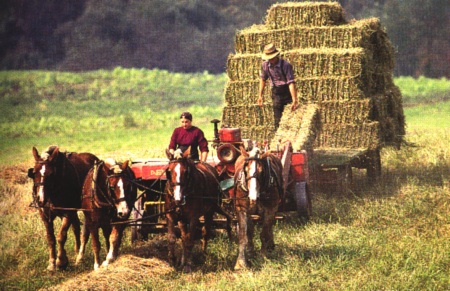
Below are some of the new hay equipment on display, mowers, rakes, balers, etc. Hay making is critical for the Amish as they require a steady supply to feed their horses and other livestock throughout the year whenever pasture is not available. Raising hay for Amish would be like an "English" farmer pumping his own oil and refining it right at his farm to run his machinery with.
Of course there was the random team of oxen....
To encourage and promote the combination of animal power and the latest equipment innovations in an effort to support sustainable small scale farming and land stewardship.To show draft animal power is possible, practical and profitable.As you can imagine, an event about animal (i.e. horse for the most part) powered farming draws lots of Amish but this is not an exhibition of rusty old obsolete stuff you would see rotting behind a barn. The show featured some incredible technology on display and I can tell you from first hand knowledge that many Amish are far more profitable in their enterprises than the most modern "English" farms with their fancy and expensive tractors and combines. I took some pictures, some include Amish which they don't like but as I was taking a picture of something else they ended up in I guess it is OK.
Below are some of the new hay equipment on display, mowers, rakes, balers, etc. Hay making is critical for the Amish as they require a steady supply to feed their horses and other livestock throughout the year whenever pasture is not available. Raising hay for Amish would be like an "English" farmer pumping his own oil and refining it right at his farm to run his machinery with.
As you might expect there were a handful of buggies on the lot although a lot of people came from all over the country and even some from overseas. Lots and lots and lots of 15 passenger vans, mine included, filled the parking area. One thing that sets "Northern Indiana" Amish apart from our local Amish, other than the manner of dressing, is that they ride bikes everywhere so there were probably as many bikes parked as buggies. Coming and going down the main road leading to the exhibition there were far more bikes on the road than buggies.
My favorite team of draft animals were this duo of Mammoth donkeys. Note the sign on the harness, "Not A Mule", which cracked me up for some reason. This mower is ground driven, so rather than a horse drawn implement that runs on hydraulics and gears driven by a gas powered engine, the action of pulling the implement causes the mower bar to run. It is very quiet compared to the gas powered mowers and does a pretty good job. It is probably more "traditional" than the gas powered mowers so it is kinda ironic that an "English" guy is driving it with mules instead of an Amish guy with horses.
Another couple of teams I liked were a team of Norwegian Fjord horses (the cream colored team) and a team of spotted draft horses (the spotted team of course). While there were a ton of Belgian and Percheron teams which are of course beautiful and powerful, I see those up close all the time but these breeds are rather rare and I think more aesthetically appealing than the plain brown or black drafts. Draft horses are utilitarian so power trumps beauty but for those who don't make a living with them I like some of the more unusual breeds:
So all and all a pretty good time. This event is in Pennsylvania next year, it moves around the country although usually near the Amish, so I doubt we will make it but it was a fascinating look at a way of farming that is both very, very old and traditional while at the same time very modern and efficient.
Tuesday, September 29, 2015
Repost: A Season of Consummation and Melancholy
Thanks to a dry late summer harvest is moving along already so I thought this was a good time to repost this essay, one of the more thoughtful and less angry in my stable.
--------
As October swiftly winds down here in Indiana I am reminded anew of the uniqueness of autumn in the Midwest. There is just something special when you live here out in the country that isn't replicated in other places we have lived around the nation . Sure New England has the fall colors and "Up North" Michigan has hunting season in the brilliant fall hues of seemingly endless forests. More southerly states have delightful weather, the fall in Kentucky was a wonderful relief from the oppressive summer heat. I am sure other regions of our fair nation have their own charms in autumn but none match the Midwest for me. Perhaps it is just the natural affinity for the place one grew up. Whatever it is nowhere we have lived can match the fall in the Midwest. It is something that is a part of what makes us who we are.
While suburbs mark the changing of the season from summer to fall with going back to school, curbside piles of leaves to picked up and the beginning of the Halloween/Thanksgiving/Christmas holiday season (a shopping season that is starting to blur together into one massive frenzy of shopping and consumption), autumn in the Midwest means the harvest. Not the harvest in the sense of "Harvest festivals" and a few corn stalks in your yard. I mean real harvest. All around us for the past few weeks the quiet fields of corn and soybeans went from the passive state of green to a frenzy of activity. Combines mowed down acre after acre of crops while trucks and tractors hauled away what is estimated to be the largest corn harvest in American history. It is incredible to watch fields of beans and corn disappear into the maw of a combine and turn into rivers of golden corn and beige soybeans.
In a unique and jarring contrast we also have the local Amish harvesting their crops. In one field you have a state of the art John Deere combine, a machine that will set you back in excess of half a million dollars, with the ability to cut up to 18 rows of corn at a time sweeping through fields, casting the discarded husks and stalks behind before emptying into huge tractor trailer trucks, trucks often lined up three deep because a modern combine can fill a tractor trailer faster than they can get to the grain elevator to dump the crop before rushing back. The pinnacle of American agricultural progress and innovation on display. In the next field you might have a team of four Belgian draft horses plodding slowly but surely through a field of corn, pulling a corn picker that harvests two rows at a time. Instead of corn that has been plucked from the stalk, husk removed and shaken and sifted through screens leaving just the kernel behind, the Amish fill their wagons with corn still on the cob. Rather than ending up in giant concrete silos, their corn often ends up in corn cribs at their home. While they have some modern conveniences, they harvest their corps in much the same way that farmers did in those same fields 100 years ago. Reminiscent of an agricultural John Henry versus the steam powered hammer, the Amish thrive using methods that seem quaint to our eyes and yet they prosper, often beyond their "English" counterparts.
The harvest is a season of accomplishment and consummation but it is also a wistful and melancholy time. The promise of harvest, just a whisper and a hope in spring as bare fields sit seemingly dormant while the seeds beneath the soil stir and grow unseen, has come to fruition. In normal years all the worry and fretting of impotently watching the weather to catch a window between the time the crops are ready and the fall rains vanishes as the crops come off as they almost always do. Farming makes for a powerful dichotomy, on the one hand farmers today have unimaginable technology at their fingertips. Precision farming, super efficient machinery, hybrid crops that produce unnatural yields, chemicals of all sorts to increase productivity and eliminate weeds and pests, all work together to squeeze every possible bushel out of an acre of land. Yet in spite of all the technology the farmer still spends most of the year on the sidelines, completely helpless waiting on the weather. Is it warm enough to plant but dry enough to get in the field? Is it hot and sunny but not too dry in the summer? Are the crops mature and dry enough to harvest but has the rain held off so we can get those green, red and orange behemoth machines in the field to harvest? I can't think of another economic endeavor that is so critical to our national economic security, so ancient and yet driven by technology, that is still dependent on something as fickle and primal as the weather.
There is something sad about the vast fields bereft of crops. Where once there were acres of tall, green corn softly rustling in the win there is now only stubble. In one field near our home the corn is all gone except for the solitary stalk standing all alone, sole sole survivor of the combine. I know that empty fields mean successful harvests and that those fields are testament to overflowing grain silos holding the American treasure from the breadbasket of our nation. I know that many farm families are smiling as they get their checks, the reward for a year of hard work and worrying. Still they make me sad. Empty bean and corn fields mean that winter is coming, just around the corner. The days will grow shorter and the extra darkness each day that I dread is also on the horizon. The joy of spring with new life in budding plants, fields being planted, lambs and foals being born, it all seems so far away, a distant and unattainable dream. I know that the winter is but a brief interlude and soon enough the horse drawn planters will be working the fields alongside massive tractors but that certainty is not enough to offset the melancholy that invariably settles on me each year at this time.
It is all part of the love-hate relationship so many of us have with the Midwest. Ours is a region that is sneered at by other parts of the country, derided as "fly over" country, an obstacle to fly over going from one fabulous place to another. It is a vast, flat landscape that is so awful to drive through but for many of us it is home, something deeply connected with who we are. So many of us strive for relevance and hipness but choose to live in a decidedly un-hip and in the eyes of many irrelevant region. In spite of the melancholy I feel in fall, the humid summers, muddy springs and freezing winters there is nowhere else that we feel so at home. This is where we belong, amid the generally simple people who make their living building stuff, moving stuff and of course farming. It is not glamorous, just like our football teams in the Big Ten are not glamorous (and not very good right now) but it is home.
Autumn in the Midwest. There is nothing else quite like it.
--------
As October swiftly winds down here in Indiana I am reminded anew of the uniqueness of autumn in the Midwest. There is just something special when you live here out in the country that isn't replicated in other places we have lived around the nation . Sure New England has the fall colors and "Up North" Michigan has hunting season in the brilliant fall hues of seemingly endless forests. More southerly states have delightful weather, the fall in Kentucky was a wonderful relief from the oppressive summer heat. I am sure other regions of our fair nation have their own charms in autumn but none match the Midwest for me. Perhaps it is just the natural affinity for the place one grew up. Whatever it is nowhere we have lived can match the fall in the Midwest. It is something that is a part of what makes us who we are.
While suburbs mark the changing of the season from summer to fall with going back to school, curbside piles of leaves to picked up and the beginning of the Halloween/Thanksgiving/Christmas holiday season (a shopping season that is starting to blur together into one massive frenzy of shopping and consumption), autumn in the Midwest means the harvest. Not the harvest in the sense of "Harvest festivals" and a few corn stalks in your yard. I mean real harvest. All around us for the past few weeks the quiet fields of corn and soybeans went from the passive state of green to a frenzy of activity. Combines mowed down acre after acre of crops while trucks and tractors hauled away what is estimated to be the largest corn harvest in American history. It is incredible to watch fields of beans and corn disappear into the maw of a combine and turn into rivers of golden corn and beige soybeans.
In a unique and jarring contrast we also have the local Amish harvesting their crops. In one field you have a state of the art John Deere combine, a machine that will set you back in excess of half a million dollars, with the ability to cut up to 18 rows of corn at a time sweeping through fields, casting the discarded husks and stalks behind before emptying into huge tractor trailer trucks, trucks often lined up three deep because a modern combine can fill a tractor trailer faster than they can get to the grain elevator to dump the crop before rushing back. The pinnacle of American agricultural progress and innovation on display. In the next field you might have a team of four Belgian draft horses plodding slowly but surely through a field of corn, pulling a corn picker that harvests two rows at a time. Instead of corn that has been plucked from the stalk, husk removed and shaken and sifted through screens leaving just the kernel behind, the Amish fill their wagons with corn still on the cob. Rather than ending up in giant concrete silos, their corn often ends up in corn cribs at their home. While they have some modern conveniences, they harvest their corps in much the same way that farmers did in those same fields 100 years ago. Reminiscent of an agricultural John Henry versus the steam powered hammer, the Amish thrive using methods that seem quaint to our eyes and yet they prosper, often beyond their "English" counterparts.
The harvest is a season of accomplishment and consummation but it is also a wistful and melancholy time. The promise of harvest, just a whisper and a hope in spring as bare fields sit seemingly dormant while the seeds beneath the soil stir and grow unseen, has come to fruition. In normal years all the worry and fretting of impotently watching the weather to catch a window between the time the crops are ready and the fall rains vanishes as the crops come off as they almost always do. Farming makes for a powerful dichotomy, on the one hand farmers today have unimaginable technology at their fingertips. Precision farming, super efficient machinery, hybrid crops that produce unnatural yields, chemicals of all sorts to increase productivity and eliminate weeds and pests, all work together to squeeze every possible bushel out of an acre of land. Yet in spite of all the technology the farmer still spends most of the year on the sidelines, completely helpless waiting on the weather. Is it warm enough to plant but dry enough to get in the field? Is it hot and sunny but not too dry in the summer? Are the crops mature and dry enough to harvest but has the rain held off so we can get those green, red and orange behemoth machines in the field to harvest? I can't think of another economic endeavor that is so critical to our national economic security, so ancient and yet driven by technology, that is still dependent on something as fickle and primal as the weather.
There is something sad about the vast fields bereft of crops. Where once there were acres of tall, green corn softly rustling in the win there is now only stubble. In one field near our home the corn is all gone except for the solitary stalk standing all alone, sole sole survivor of the combine. I know that empty fields mean successful harvests and that those fields are testament to overflowing grain silos holding the American treasure from the breadbasket of our nation. I know that many farm families are smiling as they get their checks, the reward for a year of hard work and worrying. Still they make me sad. Empty bean and corn fields mean that winter is coming, just around the corner. The days will grow shorter and the extra darkness each day that I dread is also on the horizon. The joy of spring with new life in budding plants, fields being planted, lambs and foals being born, it all seems so far away, a distant and unattainable dream. I know that the winter is but a brief interlude and soon enough the horse drawn planters will be working the fields alongside massive tractors but that certainty is not enough to offset the melancholy that invariably settles on me each year at this time.
It is all part of the love-hate relationship so many of us have with the Midwest. Ours is a region that is sneered at by other parts of the country, derided as "fly over" country, an obstacle to fly over going from one fabulous place to another. It is a vast, flat landscape that is so awful to drive through but for many of us it is home, something deeply connected with who we are. So many of us strive for relevance and hipness but choose to live in a decidedly un-hip and in the eyes of many irrelevant region. In spite of the melancholy I feel in fall, the humid summers, muddy springs and freezing winters there is nowhere else that we feel so at home. This is where we belong, amid the generally simple people who make their living building stuff, moving stuff and of course farming. It is not glamorous, just like our football teams in the Big Ten are not glamorous (and not very good right now) but it is home.
Autumn in the Midwest. There is nothing else quite like it.
Wednesday, September 09, 2015
Saturday, August 29, 2015
Hay And Love
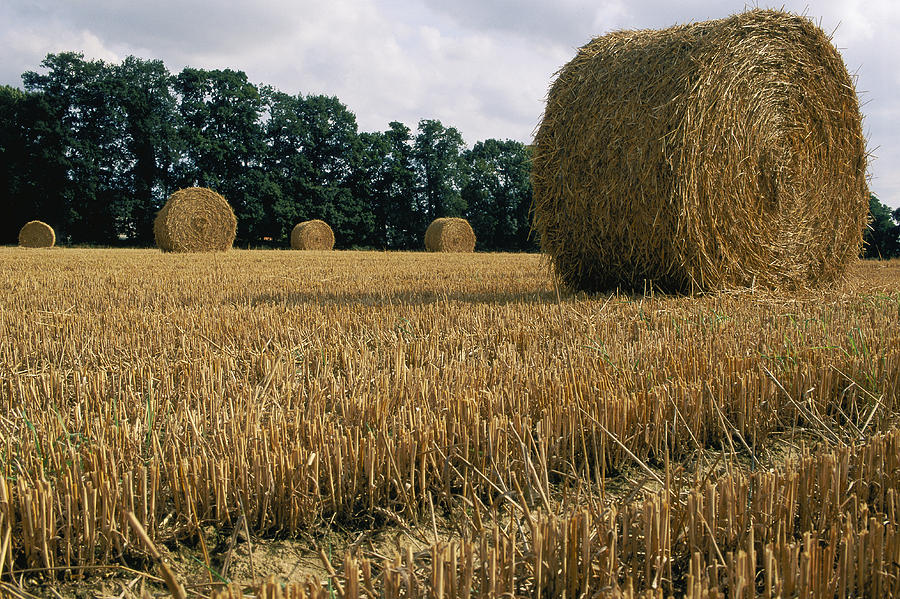
Driving around yesterday where we live almost anywhere you went you could smell freshly mowed and raked hay fields. That is such a wonderful smell. With thousands of Amish in close proximity to our home, everywhere you looked there were farmers, Amish and English alike, cutting, raking and baling hay for the winter. Watching the English with their high tech equipment and then watching the Amish with the plodding but mighty draft horses is such a contrast but when you look at their houses it looks like the Amish are prospering more with less technology. What is especially awesome is when you are out of the car and can not only watch but listen. All you hear are the sounds of the horses doing what they love, leaning into the harness and pulling hay rakes and hay wagons. The soft jingle of their harness out in the open air while they do what man and beast have worked symbiotically together for centuries to accomplish in the never-ending change of the seasons reminds me that bigger and louder is not necessarily better. Farming the way the Amish do seems almost quaint but I don't think many of the Amish envy their English neighbors and the environmentally controlled cabs of their massive tractors with a commensurately massive loan payments.
How different the times and seasons are when you spend a lot of your summer preparing for fall and winter rather than looking ahead to the next vacation or the start of the Christmas shopping season. The rhythms of the seasons in the Midwest are very meaningful for those of us who grew up here and choose to live here and it always brings back memories. For me the smell of freshly mowed hay means more than feed for our livestock this winter, it takes me back to my younger days when I was an insufferable kid dating the woman who would be my wife.
Part of the process of courting my wife included helping with the hay when her dad cut it back when his health was better. That was not much fun because the bales were bound with wire making it possible to make them much heavier than hay bales bound with twine. Some of the bales weighed more than half of what I did back then. Plus I didn't really know what I was doing which made me feel awkward, something I hate. To top it off my wife's brother would toss bales like he was playing corn-hole, which is made easier by him being a giant who was immensely strong. I was pretty strong for a 125 pound kid but each bale was a major effort. Lifting weights in the gym is not quite the same as using your whole body to manhandle a bale of hay.
When I was living in those days of sweating, sore backs and arms that looked like a herd of cats had used them for a scratching post it wasn't much fun but looking back it was all well worth the effort and irritation. I am not sure her dad ever thought I would amount to much but I have to believe it earned me some grudging respect to go toe to toe with the hay bales.
Those days seem so long ago but I still remember the smell of hay and it reminds me of my wife. She would be out there with the men, working every bit as hard but smiling all the while. Hard work never bothered her and I tell skeptical Amish guys all the time that back in the day she could work every bit as hard as an Amish woman or even an Amish man. Stacking hay bales in the barn seems an odd thing to remind me of her but I recall those days and the smell of hay reminds me of how blessed I am to have a faithful wife of more than twenty years and eight children that we love. Our oldest son is out of the house every morning before 7 AM to go work on Amish farm and I see in him so much of what I respect about my wife. My other sons will head out later to care for our pigs, horses and cattle. My daughters are bright and beautiful and the two older girls spent part of their summer in Nicaragua and Nepal serving Christ.
My ungrateful and vain younger self would be shocked and disappointed at how we choose to live but I look around at my family and especially my wife when I see hay being made and wouldn't trade it for anything in the world.
How different the times and seasons are when you spend a lot of your summer preparing for fall and winter rather than looking ahead to the next vacation or the start of the Christmas shopping season. The rhythms of the seasons in the Midwest are very meaningful for those of us who grew up here and choose to live here and it always brings back memories. For me the smell of freshly mowed hay means more than feed for our livestock this winter, it takes me back to my younger days when I was an insufferable kid dating the woman who would be my wife.
Part of the process of courting my wife included helping with the hay when her dad cut it back when his health was better. That was not much fun because the bales were bound with wire making it possible to make them much heavier than hay bales bound with twine. Some of the bales weighed more than half of what I did back then. Plus I didn't really know what I was doing which made me feel awkward, something I hate. To top it off my wife's brother would toss bales like he was playing corn-hole, which is made easier by him being a giant who was immensely strong. I was pretty strong for a 125 pound kid but each bale was a major effort. Lifting weights in the gym is not quite the same as using your whole body to manhandle a bale of hay.
When I was living in those days of sweating, sore backs and arms that looked like a herd of cats had used them for a scratching post it wasn't much fun but looking back it was all well worth the effort and irritation. I am not sure her dad ever thought I would amount to much but I have to believe it earned me some grudging respect to go toe to toe with the hay bales.
Those days seem so long ago but I still remember the smell of hay and it reminds me of my wife. She would be out there with the men, working every bit as hard but smiling all the while. Hard work never bothered her and I tell skeptical Amish guys all the time that back in the day she could work every bit as hard as an Amish woman or even an Amish man. Stacking hay bales in the barn seems an odd thing to remind me of her but I recall those days and the smell of hay reminds me of how blessed I am to have a faithful wife of more than twenty years and eight children that we love. Our oldest son is out of the house every morning before 7 AM to go work on Amish farm and I see in him so much of what I respect about my wife. My other sons will head out later to care for our pigs, horses and cattle. My daughters are bright and beautiful and the two older girls spent part of their summer in Nicaragua and Nepal serving Christ.
My ungrateful and vain younger self would be shocked and disappointed at how we choose to live but I look around at my family and especially my wife when I see hay being made and wouldn't trade it for anything in the world.
Tuesday, May 05, 2015
This Little Swine Of Mine, I'm Gonna Let It Shine
I listened to this piece on NPR today about a new book on the history of hog farming, Pig Tales: An Omnivore's Quest for Sustainable Meat.
Sounds like an interesting read. We raise pigs on a very small scale and our pigs have access to the sun and sky and often to our pasture where they help turn the soil. Our pigs know us and come over to see us when we come near, even our rather massive boar who likes to be scratched behind his ears. We also eat them even when it is sometimes bittersweet. That is how it should be when you take responsibility for raising an animal and take responsibility for taking their life in order to eat them. We raise mostly Tamworth hogs with a couple of Berkshire and Berkshire cross sows thrown in. They definitely don't grow as fast but we are willing to trade some speed for quality and humane treatment.
The author is a little prone to exaggeration and is overly fond of litigation but his general point is correct, namely that there is a breaking point down the road where industrial agriculture is going to run into serious problems. Whether it is too much concentrated waste, disease (like the current avian flu outbreak and last year's devastating hog kill off), new strains of antibiotic resistant diseases tied to overuse of antibiotics in industrial ag or a major collapse of the distribution system, something bad is coming down the road and soon. Hopefully we as a society will wise up before that happens because a major (or even minor) disruption in the food supply would cause an explosion of social unrest that would make the looting in Baltimore look like a hug-fest.
Sounds like an interesting read. We raise pigs on a very small scale and our pigs have access to the sun and sky and often to our pasture where they help turn the soil. Our pigs know us and come over to see us when we come near, even our rather massive boar who likes to be scratched behind his ears. We also eat them even when it is sometimes bittersweet. That is how it should be when you take responsibility for raising an animal and take responsibility for taking their life in order to eat them. We raise mostly Tamworth hogs with a couple of Berkshire and Berkshire cross sows thrown in. They definitely don't grow as fast but we are willing to trade some speed for quality and humane treatment.
The author is a little prone to exaggeration and is overly fond of litigation but his general point is correct, namely that there is a breaking point down the road where industrial agriculture is going to run into serious problems. Whether it is too much concentrated waste, disease (like the current avian flu outbreak and last year's devastating hog kill off), new strains of antibiotic resistant diseases tied to overuse of antibiotics in industrial ag or a major collapse of the distribution system, something bad is coming down the road and soon. Hopefully we as a society will wise up before that happens because a major (or even minor) disruption in the food supply would cause an explosion of social unrest that would make the looting in Baltimore look like a hug-fest.
Friday, April 24, 2015
Oh the irony, Episode #1,455: Quit farming the way we pay you to farm!
Our benevolent overlords in Washington, D.C. have turned their keen intuition to a new frontier in the fight against global warming climate change, our nation's agricultural system.
Our government subsidizes in every way the system of agriculture that demands huge machinery, confinement operations, massive chemical application, burning of enormous amounts of fossil fuels, going to war to keep that fuel "cheap", etc. and then wants those same farmers to "reduce emissions" to combat the mythical "climate change". Only in America does that inherent contradiction not seem apparent to any and all. People will mostly do what they have an incentive to do so if you provide an incentive to farm that way and disincentives to farm any other way (like armed raids on those who sell "raw milk").
Thanks to the "get big or get out" mentality, our farms have gotten bigger and bigger with each passing year. Our land grant universities put out a largely monolithic message that reinforces this because they are subsidized by the big agribusiness firms that profit from the industrial farming system. Our government pays farmers and subsidizes them in various ways that make it almost impossible to not have giant machinery that spew carbon, compact the soil and require massive doses of chemicals. The same is true of animal husbandry that makes it incredibly difficult to raise livestock profitably unless you accept the industrialized, subsidized system which requires you to cram more and more livestock into your facility which in turn concentrates methane, creates mountains or lakes of manure that need to be disposed of, requires unhealthy doses of antibiotics and depends entirely on cheap feed grains which in turn require....huge, carbon emission spewing tractors. We are paying people to do the very thing that we want them to do less of. America, what a country!
Stuff like this is why I appreciate writers like Joel Salatin, Wendell Berry, Gene Logsdon and David Kline. Rather than hipsters who want to farm so they can have a beard and be groovy, these are guys who are actually farming the way it can and should be done. I am under no illusion that a substantial portion of the population is going to start 20-30 acre farms, I mean seriously, we can't get a lot of people to even get a job and those that do want an exorbitant hourly wage for unskilled work. But if we can get more people to start farming like this it will certainly help to stem a small part of the tide and perhaps even avoid the seemingly inevitable food catastrophe that I see in our future.
Federal agricultural officials announced Thursday voluntary programs and initiatives for farmers, ranchers and foresters meant to build on President Barack Obama's efforts to combat global warming — and they don't require congressional approval.Gotta love the sweeping new powers that our President has granted himself. No Congressional approval needed. How long until "No Congress needed at all" is the law of the land? So how exactly are we going to conquer "climate change" via "voluntary" cutbacks to carbon emissions? Easy!
Specific actions include reducing the unnecessary use of fertilizer and methane emissions from cattle and swine, reforesting areas damaged by wildfire and disease and encouraging tree planting in urban areas. For methane reduction in particular, the federal program promotes installing more anaerobic digesters, which use naturally occurring bacteria to break down organic waste to produce biogas, a fuel similar to natural gas.Oh the irony....
Our government subsidizes in every way the system of agriculture that demands huge machinery, confinement operations, massive chemical application, burning of enormous amounts of fossil fuels, going to war to keep that fuel "cheap", etc. and then wants those same farmers to "reduce emissions" to combat the mythical "climate change". Only in America does that inherent contradiction not seem apparent to any and all. People will mostly do what they have an incentive to do so if you provide an incentive to farm that way and disincentives to farm any other way (like armed raids on those who sell "raw milk").
Thanks to the "get big or get out" mentality, our farms have gotten bigger and bigger with each passing year. Our land grant universities put out a largely monolithic message that reinforces this because they are subsidized by the big agribusiness firms that profit from the industrial farming system. Our government pays farmers and subsidizes them in various ways that make it almost impossible to not have giant machinery that spew carbon, compact the soil and require massive doses of chemicals. The same is true of animal husbandry that makes it incredibly difficult to raise livestock profitably unless you accept the industrialized, subsidized system which requires you to cram more and more livestock into your facility which in turn concentrates methane, creates mountains or lakes of manure that need to be disposed of, requires unhealthy doses of antibiotics and depends entirely on cheap feed grains which in turn require....huge, carbon emission spewing tractors. We are paying people to do the very thing that we want them to do less of. America, what a country!
Stuff like this is why I appreciate writers like Joel Salatin, Wendell Berry, Gene Logsdon and David Kline. Rather than hipsters who want to farm so they can have a beard and be groovy, these are guys who are actually farming the way it can and should be done. I am under no illusion that a substantial portion of the population is going to start 20-30 acre farms, I mean seriously, we can't get a lot of people to even get a job and those that do want an exorbitant hourly wage for unskilled work. But if we can get more people to start farming like this it will certainly help to stem a small part of the tide and perhaps even avoid the seemingly inevitable food catastrophe that I see in our future.
It just kills me that the government says and does stuff like this and no one even sees how dumb it is.
Monday, October 13, 2014
Repost: A Season of Consummation and Melancholy
Last year about this time I wrote this post on the rhythm of agricultural life in the Midwest. The nearly twelve months that have elapsed since I wrote this have been very difficult for me and for my family. I am not prepared or inclined to share much more but it has been one of the most trying seasons we have endured. As I look back and hopefully learn this post came to mind.
------
As October swiftly winds down here in Indiana I am reminded anew of the uniqueness of autumn in the Midwest. There is just something special when you live here out in the country that isn't replicated in other places we have lived around the nation . Sure New England has the fall colors and "Up North" Michigan has hunting season in the brilliant fall hues of seemingly endless forests. More southerly states have delightful weather, when we lived there the fall in Kentucky was a wonderful relief from the oppressive summer heat. I am sure other regions of our fair nation have their own charms in autumn but none match the Midwest for me. Perhaps it is just the natural affinity for the place one grew up. Whatever it is, nowhere we have lived can match autumn in the Midwest. It is something that is a part of what makes us who we are.
While suburbs mark the changing of the season from summer to fall with going back to school, curbside piles of leaves to picked up and the beginning of the Halloween/Thanksgiving/Christmas holiday season (a shopping season that is starting to blur together into one massive frenzy of shopping and consumption), autumn in the Midwest means the harvest. Not the harvest in the sense of "Harvest festivals" and a few corn stalks in your yard. I mean real harvest. All around us for the past few weeks the quiet fields of corn and soybeans went from the passive state of green to a frenzy of activity. Combines mowed down acre after acre of crops while trucks and tractors hauled away what is estimated to be the largest corn harvest in American history. It is incredible to watch fields of beans and corn disappear into the maw of a combine and turn into rivers of golden corn and beige soybeans.
In a unique and jarring contrast we also have the local Amish harvesting their crops. In one field you have a state of the art John Deere combine, a machine that will set you back in excess of half a million dollars, with the ability to cut up to 18 rows of corn at a time sweeping through fields, casting the discarded husks and stalks behind before emptying into huge tractor trailer trucks, trucks often lined up three deep because a modern combine can fill a tractor trailer faster than they can get to the grain elevator to dump the crop before rushing back. It is the pinnacle of American agricultural progress and innovation on display, the one industry where America is still second to none. In the next field you might have a team of four Belgian draft horses plodding slowly but surely through a field of corn, pulling a corn picker that harvests two rows at a time. Instead of corn that has been plucked from the stalk, husk removed and shaken and sifted through screens leaving just the kernel behind, the Amish fill their wagons with corn still on the cob. Rather than ending up in giant concrete silos, their corn often ends up in corn cribs at their home. While they have some modern conveniences, they harvest their corps in much the same way that farmers did in those same fields 100 years ago. Reminiscent of an agricultural John Henry versus the steam powered hammer, the Amish thrive using methods that seem quaint to our eyes and yet they prosper, often beyond their "English" counterparts.
The harvest is a season of accomplishment and consummation but it is also a wistful and melancholy time. The promise of harvest, just a whisper and a hope in spring as bare fields sit seemingly dormant while the seeds beneath the soil stir and grow unseen, has come to fruition. In normal years all the worry and fretting of impotently watching the weather to catch a window between the time the crops are ready and the fall rains vanishes as the crops come off as they almost always do. Farming makes for a powerful dichotomy, on the one hand farmers today have unimaginable technology at their fingertips. Precision farming, super efficient machinery, hybrid crops that produce unnatural yields, chemicals of all sorts to increase productivity and eliminate weeds and pests, all work together to squeeze every possible bushel out of an acre of land. Yet in spite of all the technology the farmer still spends most of the year on the sidelines, completely helpless waiting on the weather. Is it warm enough to plant but dry enough to get in the field? Is it hot and sunny but not too dry in the summer? Are the crops mature and dry enough to harvest but has the rain held off so we can get those green, red and orange behemoth machines in the field to harvest? I can't think of another economic endeavor that is so critical to our national economic security, so ancient and yet driven by technology, that is still dependent on something as fickle and primal as the weather.
There is something sad about the vast fields bereft of crops. Where once there were acres of tall, green corn softly rustling in the wind there is now only stubble. In one field near our home the corn is all gone except for the solitary stalk standing all alone, sole sole survivor of the combine. I know that empty fields mean successful harvests and that those fields are testament to overflowing grain silos holding the American treasure from the breadbasket of our nation. I know that many farm families are smiling as they get their checks, the reward for a year of hard work and worrying. Still they make me sad. Empty bean and corn fields mean that winter is coming, just around the corner. The days will grow shorter and the extra darkness each day that I dread is also on the horizon. The joy of spring with new life in budding plants, fields being planted, lambs and foals being born, it all seems so far away, a distant and unattainable dream. I know that the winter is but a brief interlude and soon enough the horse drawn planters will be working the fields alongside massive tractors but that certainty is not enough to offset the melancholy that invariably settles on me each year at this time.
It is all part of the love-hate relationship so many of us have with the Midwest. Ours is a region that is sneered at by other parts of the country, derided as "fly over" country, an obstacle to fly over going from one fabulous place to another. It is a vast, flat landscape that is so awful to drive through but for many of us it is home, something deeply connected with who we are. So many of us strive for relevance and hipness but choose to live in a decidedly un-hip and in the eyes of many irrelevant region. In spite of the melancholy I feel in fall, the humid summers, muddy springs and freezing winters there is nowhere else that we feel so at home. This is where we belong, amid the generally simple people who make their living building stuff, moving stuff and of course farming. It is not glamorous, just like our football teams in the Big Ten are not glamorous (and not very good right now) but it is home.
Autumn in the Midwest. There is nothing else quite like it.
We spent some time over the last week opening up a corn
field. That isn't something you see in industrialized agriculture where the
monstrous combines rapidly blaze through a corn field, slowed mostly by the
need to continually unload the corn or beans before returning to harvesting at speeds that would be incomprehensible to farmers a few generations ago. Opening up a corn field is an Amish thing, creating space on the ends and through the middle for the horses to walk while pulling the corn picker. As we worked as a family in the field in near silence from our surroundings other than the whispering rustle of corn in the autumn breeze, I was thinking about how the seasons of life parallel the seasons of the harvest. When I was younger and my children were as well I did the heavy lifting. Now as the years slowly take their toll on my body while hopefully doing the opposite for my wisdom I rely more and more on my children. My older kids are the strong arms to chop corn and the younger are the strong backs to bend over to pick up ears of corn again and again never seeming to weary. On a farm kids are more than decorative ornaments to adorn our Christmas cards and Facebook pages, they are an integral part of daily life. On many farms they are nothing less that indispensable. Were it not for my kids we wouldn't have fresh raw milk to drink. Most of the more demanding chores around the farm wouldn't get done. Each year that passes sees a subtle shifting from parents to children. It is a fascinating progression to watch once you get over the fact that you are the one getting older and the inevitable jolt to the ego that comes from having your son handle something that you probably could still do but really shouldn't. All is part of the Creator's grand design for life.
As October swiftly winds down here in Indiana I am reminded anew of the uniqueness of autumn in the Midwest. There is just something special when you live here out in the country that isn't replicated in other places we have lived around the nation . Sure New England has the fall colors and "Up North" Michigan has hunting season in the brilliant fall hues of seemingly endless forests. More southerly states have delightful weather, when we lived there the fall in Kentucky was a wonderful relief from the oppressive summer heat. I am sure other regions of our fair nation have their own charms in autumn but none match the Midwest for me. Perhaps it is just the natural affinity for the place one grew up. Whatever it is, nowhere we have lived can match autumn in the Midwest. It is something that is a part of what makes us who we are.
While suburbs mark the changing of the season from summer to fall with going back to school, curbside piles of leaves to picked up and the beginning of the Halloween/Thanksgiving/Christmas holiday season (a shopping season that is starting to blur together into one massive frenzy of shopping and consumption), autumn in the Midwest means the harvest. Not the harvest in the sense of "Harvest festivals" and a few corn stalks in your yard. I mean real harvest. All around us for the past few weeks the quiet fields of corn and soybeans went from the passive state of green to a frenzy of activity. Combines mowed down acre after acre of crops while trucks and tractors hauled away what is estimated to be the largest corn harvest in American history. It is incredible to watch fields of beans and corn disappear into the maw of a combine and turn into rivers of golden corn and beige soybeans.
In a unique and jarring contrast we also have the local Amish harvesting their crops. In one field you have a state of the art John Deere combine, a machine that will set you back in excess of half a million dollars, with the ability to cut up to 18 rows of corn at a time sweeping through fields, casting the discarded husks and stalks behind before emptying into huge tractor trailer trucks, trucks often lined up three deep because a modern combine can fill a tractor trailer faster than they can get to the grain elevator to dump the crop before rushing back. It is the pinnacle of American agricultural progress and innovation on display, the one industry where America is still second to none. In the next field you might have a team of four Belgian draft horses plodding slowly but surely through a field of corn, pulling a corn picker that harvests two rows at a time. Instead of corn that has been plucked from the stalk, husk removed and shaken and sifted through screens leaving just the kernel behind, the Amish fill their wagons with corn still on the cob. Rather than ending up in giant concrete silos, their corn often ends up in corn cribs at their home. While they have some modern conveniences, they harvest their corps in much the same way that farmers did in those same fields 100 years ago. Reminiscent of an agricultural John Henry versus the steam powered hammer, the Amish thrive using methods that seem quaint to our eyes and yet they prosper, often beyond their "English" counterparts.
The harvest is a season of accomplishment and consummation but it is also a wistful and melancholy time. The promise of harvest, just a whisper and a hope in spring as bare fields sit seemingly dormant while the seeds beneath the soil stir and grow unseen, has come to fruition. In normal years all the worry and fretting of impotently watching the weather to catch a window between the time the crops are ready and the fall rains vanishes as the crops come off as they almost always do. Farming makes for a powerful dichotomy, on the one hand farmers today have unimaginable technology at their fingertips. Precision farming, super efficient machinery, hybrid crops that produce unnatural yields, chemicals of all sorts to increase productivity and eliminate weeds and pests, all work together to squeeze every possible bushel out of an acre of land. Yet in spite of all the technology the farmer still spends most of the year on the sidelines, completely helpless waiting on the weather. Is it warm enough to plant but dry enough to get in the field? Is it hot and sunny but not too dry in the summer? Are the crops mature and dry enough to harvest but has the rain held off so we can get those green, red and orange behemoth machines in the field to harvest? I can't think of another economic endeavor that is so critical to our national economic security, so ancient and yet driven by technology, that is still dependent on something as fickle and primal as the weather.
There is something sad about the vast fields bereft of crops. Where once there were acres of tall, green corn softly rustling in the wind there is now only stubble. In one field near our home the corn is all gone except for the solitary stalk standing all alone, sole sole survivor of the combine. I know that empty fields mean successful harvests and that those fields are testament to overflowing grain silos holding the American treasure from the breadbasket of our nation. I know that many farm families are smiling as they get their checks, the reward for a year of hard work and worrying. Still they make me sad. Empty bean and corn fields mean that winter is coming, just around the corner. The days will grow shorter and the extra darkness each day that I dread is also on the horizon. The joy of spring with new life in budding plants, fields being planted, lambs and foals being born, it all seems so far away, a distant and unattainable dream. I know that the winter is but a brief interlude and soon enough the horse drawn planters will be working the fields alongside massive tractors but that certainty is not enough to offset the melancholy that invariably settles on me each year at this time.
It is all part of the love-hate relationship so many of us have with the Midwest. Ours is a region that is sneered at by other parts of the country, derided as "fly over" country, an obstacle to fly over going from one fabulous place to another. It is a vast, flat landscape that is so awful to drive through but for many of us it is home, something deeply connected with who we are. So many of us strive for relevance and hipness but choose to live in a decidedly un-hip and in the eyes of many irrelevant region. In spite of the melancholy I feel in fall, the humid summers, muddy springs and freezing winters there is nowhere else that we feel so at home. This is where we belong, amid the generally simple people who make their living building stuff, moving stuff and of course farming. It is not glamorous, just like our football teams in the Big Ten are not glamorous (and not very good right now) but it is home.
Autumn in the Midwest. There is nothing else quite like it.
Thursday, July 03, 2014
Baby pigs!
Well sort of mixed results, live baby pigs which is a marked improvement but only three so far and she looks to be done. I guess we will take the live piglets and be happy for that, not sure why the litter was so small though.
Sunday, March 02, 2014
Baby!
Unlike last year we had a successful delivery of a new baby heifer calf. She is a Jersey-Dexter cross so she will be noticeably smaller than a full sized dairy cow. We are planning on raising her up and selling her to a family that would be looking for something a little smaller than a standard dairy cow but still looking for high quality milk. Pretty exciting for us and as an added bonus she is super cute. Doesn't quite make up for losing our sow thanks to my inexperience but it is nice nonetheless. Up next should be a couple of sets of (hopefully) twin lambs any day now.
Sunday, February 16, 2014
Get Big Or Get Out
As I walked around our little 4 acre farm the today I was struck by the little things that were happening around me. Our pigs jostling for position at the trough. Chickens gingerly avoiding the voracious maw of our biggest sow while snatching bits of corn and bread the pigs had missed. Calves play fighting with each other, butting heads in an act that reminds one of the annual struggle between deer, elk and moose. Our cow in her pen, shortly to give birth to a Jersey-Dexter cross calf which will either be raised for beef or sold for breeding depending on the gender. There is a sense of deep satisfaction to see the patterns of the seasons. While we are buried in snow (thanks Al Gore) I can see the signs of springs in the swollen bellies of our pig and cow. There is a connection to the land and to the natural environment that cannot be replicated by a life lived under fluorescent lights in temperature controlled buildings. It is no coincidence that we are living longer but less healthy than ever before.
Meanwhile across the broader spectrum of agriculture we see continuing consolidation. In our little largely agrarian corner of the world farm ground sells for an astronomical sum. It is essentially impossible to buy a decent sized plot of farm ground, service the debt and pay for the inputs. The only people who can afford to buy farm ground are the already huge existing farms. Fairly near to us there is a new massive hog farm going in, to the consternation of the neighbors. The farmer in question, Keith Werner, sums it up: “I’m not reinventing the wheel here,” he said. “In order to make it today, you have to be bigger. I don’t necessarily like that, but the emphasis is on quantity.” The same holds true in this piece from Harvest Public Media, Changing dairy industry leaves some farmers in the dust.
In the past decade, more than half the nation’s dairy farms have gone out of business, according to U.S. Department of Agriculture data. About 2,500 dairies closed their doors in Missouri. Thousands more have shut down in Iowa, Kentucky, Illinois, Indiana, Nebraska and Colorado.
“It’s just a sign of the times: You’ve got to get bigger to survive,” Davidson said. “When I graduated from high school, the herds were smaller numbers and I varied very little from that. That might be the reason mine did not go on – because I didn’t increase, I just tried to stay the same.”
Get big or get out. That is the mantra of our day in agriculture. As Keith Werner says the emphasis is on quantity. Move as many animals through the system as quickly and efficiently as possible with a secondary goal of uniformity to placate the modern consumer. The same goes for crops leading to farmers planting every square inch of dirt to squeeze out a little more yield. There is a growing market for the specialty boutique farm but there isn't much room in the middle for the small producer unless he or she has a regular job to pay the bills.
Our ability as a nation to produce our own food in enormous quantities has long been the hidden strategic advantage of America. The coasts might produce the innovators and academics but the heartland raises the food and builds the goods that keep this country running. While manufacturing seems to be enjoying a sort of renaissance, our imagined food security masks a serious insecurity. The overwhelming majority of Americans are at the end of a very complex industrialized food chain. They are completely dependent on the system offering the variety and prices of food in limitless quantities they have come to rely on. Very few of us really think about food other than "what should I make for dinner tonight". Underneath this happy ignorance is a very shaky system. Our dependance on industrial farms, massive meat packing facilities, monocrop megafarms, cheap petroleum and low cost supermarket foods has made food insecurity a thing of the past for most Americans but it is an unstable platform. If a new strain of disease or pest strikes Roundup resistant soybeans we could lose an entire crop. If something happens to the cheap oil we depend on, food prices would skyrocket and food selection would disappear. The very system that makes food so cheap and (on the surface) varied also is what makes the food system so insecure.
I am a pessimist by nature, perhaps explaining why I find reformed theology so appealing. These days that is more true than ever before. I think there is trouble a'brewing in the West in general and America in particular. The growing number of disconnected, unmarried, unemployed men with nothing to live for is extremely dangerous. Our unimaginable national debt is unsustainable, not to mention the untenable social safety net especially the programs for senior citizens, much less for the poor. What happens when we can't just create more money from thin air by issuing more debt? If we have a treasury auction and no one buys? What happens when the income transfer checks suddenly stop? We saw a taste with the chaos around food stamp cards when the system went haywire and stores were ransacked. That is just a taste of what can happen. The social fabric of the West is unraveling and the repercussions will be enormous.
I am encouraged by the growing numbers of younger Americans who are shedding some of the trappings of our soulless modernity and reaching back to ancient wisdom that is in danger of being lost. One need not be a Luddite or Pollyanna to see the value in relearning the ancient ways. We can and should incorporate the many positives of our modern data-driven culture into this movement. What we cannot do is hide our collective heads in the sand and think that an inherently unsustainable and vulnerable system will exist just as it is now in perpetuity. We need to wake up. Get big or get out is a recipe for some sort of disaster. Maybe not today, maybe not next week but someday soon.
Meanwhile across the broader spectrum of agriculture we see continuing consolidation. In our little largely agrarian corner of the world farm ground sells for an astronomical sum. It is essentially impossible to buy a decent sized plot of farm ground, service the debt and pay for the inputs. The only people who can afford to buy farm ground are the already huge existing farms. Fairly near to us there is a new massive hog farm going in, to the consternation of the neighbors. The farmer in question, Keith Werner, sums it up: “I’m not reinventing the wheel here,” he said. “In order to make it today, you have to be bigger. I don’t necessarily like that, but the emphasis is on quantity.” The same holds true in this piece from Harvest Public Media, Changing dairy industry leaves some farmers in the dust.
In the past decade, more than half the nation’s dairy farms have gone out of business, according to U.S. Department of Agriculture data. About 2,500 dairies closed their doors in Missouri. Thousands more have shut down in Iowa, Kentucky, Illinois, Indiana, Nebraska and Colorado.
“It’s just a sign of the times: You’ve got to get bigger to survive,” Davidson said. “When I graduated from high school, the herds were smaller numbers and I varied very little from that. That might be the reason mine did not go on – because I didn’t increase, I just tried to stay the same.”
Get big or get out. That is the mantra of our day in agriculture. As Keith Werner says the emphasis is on quantity. Move as many animals through the system as quickly and efficiently as possible with a secondary goal of uniformity to placate the modern consumer. The same goes for crops leading to farmers planting every square inch of dirt to squeeze out a little more yield. There is a growing market for the specialty boutique farm but there isn't much room in the middle for the small producer unless he or she has a regular job to pay the bills.
Our ability as a nation to produce our own food in enormous quantities has long been the hidden strategic advantage of America. The coasts might produce the innovators and academics but the heartland raises the food and builds the goods that keep this country running. While manufacturing seems to be enjoying a sort of renaissance, our imagined food security masks a serious insecurity. The overwhelming majority of Americans are at the end of a very complex industrialized food chain. They are completely dependent on the system offering the variety and prices of food in limitless quantities they have come to rely on. Very few of us really think about food other than "what should I make for dinner tonight". Underneath this happy ignorance is a very shaky system. Our dependance on industrial farms, massive meat packing facilities, monocrop megafarms, cheap petroleum and low cost supermarket foods has made food insecurity a thing of the past for most Americans but it is an unstable platform. If a new strain of disease or pest strikes Roundup resistant soybeans we could lose an entire crop. If something happens to the cheap oil we depend on, food prices would skyrocket and food selection would disappear. The very system that makes food so cheap and (on the surface) varied also is what makes the food system so insecure.
I am a pessimist by nature, perhaps explaining why I find reformed theology so appealing. These days that is more true than ever before. I think there is trouble a'brewing in the West in general and America in particular. The growing number of disconnected, unmarried, unemployed men with nothing to live for is extremely dangerous. Our unimaginable national debt is unsustainable, not to mention the untenable social safety net especially the programs for senior citizens, much less for the poor. What happens when we can't just create more money from thin air by issuing more debt? If we have a treasury auction and no one buys? What happens when the income transfer checks suddenly stop? We saw a taste with the chaos around food stamp cards when the system went haywire and stores were ransacked. That is just a taste of what can happen. The social fabric of the West is unraveling and the repercussions will be enormous.
I am encouraged by the growing numbers of younger Americans who are shedding some of the trappings of our soulless modernity and reaching back to ancient wisdom that is in danger of being lost. One need not be a Luddite or Pollyanna to see the value in relearning the ancient ways. We can and should incorporate the many positives of our modern data-driven culture into this movement. What we cannot do is hide our collective heads in the sand and think that an inherently unsustainable and vulnerable system will exist just as it is now in perpetuity. We need to wake up. Get big or get out is a recipe for some sort of disaster. Maybe not today, maybe not next week but someday soon.
Saturday, February 01, 2014
Turning Wilbur Into Yummy Bacon
I came across this video series from Farmrun and liked it a lot. Kinda artsy fartsy but the first video was still quite good for beginners. Our sow is due to have piglets in about a week and one of our gilts is almost big enough to breed so I am hoping to stagger the breeding so we always have some pregnant, some with new piglets and some getting ready to be bred. Check out the vid, I am going to try to watch more this evening.
On The Anatomy Of Thrift: Side Butchery from farmrun on Vimeo.
Sunday, October 27, 2013
Itty Bitty Future Bacon Makers
We bought a couple of young gilts (unbred female pigs) this weekend. Unlike most of their predecessors on our farm they are not being raised to eat but rather for breeding. We have a building that we use for storage (i.e. junk) right now but it is perfect for a small hog operation, a low building with concrete floors, set up with electricity, a heater, windows for ventilation and a faucet for water right inside. The darker piglet is a Berkshire, a fairly uncommon breed known for their higher quality meat compared to the traditional industrialized factory farmed breeds. The lighter girl is a cross between a Berkshire and a Yorkshire, a more common production breed that you would likely see in 4-H shows. Our older gilt (a Hampshire) is at another farm being bred by a Berkshire cross boar. Hopefully this can be another source of revenue as hogs are generally considered to be a very efficient animal for converting feed into muscle rapidly. Besides, how cute are those piglets?!
A Season of Consummation and Melancholy
As October swiftly winds down here in Indiana I am reminded anew of the uniqueness of autumn in the Midwest. There is just something special when you live here out in the country that isn't replicated in other places we have lived around the nation . Sure New England has the fall colors and "Up North" Michigan has hunting season in the brilliant fall hues of seemingly endless forests. More southerly states have delightful weather, the fall in Kentucky was a wonderful relief from the oppressive summer heat. I am sure other regions of our fair nation have their own charms in autumn but none match the Midwest for me. Perhaps it is just the natural affinity for the place one grew up. Whatever it is nowhere we have lived can match the fall in the Midwest. It is something that is a part of what makes us who we are.
While suburbs mark the changing of the season from summer to fall with going back to school, curbside piles of leaves to picked up and the beginning of the Halloween/Thanksgiving/Christmas holiday season (a shopping season that is starting to blur together into one massive frenzy of shopping and consumption), autumn in the Midwest means the harvest. Not the harvest in the sense of "Harvest festivals" and a few corn stalks in your yard. I mean real harvest. All around us for the past few weeks the quiet fields of corn and soybeans went from the passive state of green to a frenzy of activity. Combines mowed down acre after acre of crops while trucks and tractors hauled away what is estimated to be the largest corn harvest in American history. It is incredible to watch fields of beans and corn disappear into the maw of a combine and turn into rivers of golden corn and beige soybeans.
In a unique and jarring contrast we also have the local Amish harvesting their crops. In one field you have a state of the art John Deere combine, a machine that will set you back in excess of half a million dollars, with the ability to cut up to 18 rows of corn at a time sweeping through fields, casting the discarded husks and stalks behind before emptying into huge tractor trailer trucks, trucks often lined up three deep because a modern combine can fill a tractor trailer faster than they can get to the grain elevator to dump the crop before rushing back. The pinnacle of American agricultural progress and innovation on display. In the next field you might have a team of four Belgian draft horses plodding slowly but surely through a field of corn, pulling a corn picker that harvests two rows at a time. Instead of corn that has been plucked from the stalk, husk removed and shaken and sifted through screens leaving just the kernel behind, the Amish fill their wagons with corn still on the cob. Rather than ending up in giant concrete silos, their corn often ends up in corn cribs at their home. While they have some modern conveniences, they harvest their corps in much the same way that farmers did in those same fields 100 years ago. Reminiscent of an agricultural John Henry versus the steam powered hammer, the Amish thrive using methods that seem quaint to our eyes and yet they prosper, often beyond their "English" counterparts.
The harvest is a season of accomplishment and consummation but it is also a wistful and melancholy time. The promise of harvest, just a whisper and a hope in spring as bare fields sit seemingly dormant while the seeds beneath the soil stir and grow unseen, has come to fruition. In normal years all the worry and fretting of impotently watching the weather to catch a window between the time the crops are ready and the fall rains vanishes as the crops come off as they almost always do. Farming makes for a powerful dichotomy, on the one hand farmers today have unimaginable technology at their fingertips. Precision farming, super efficient machinery, hybrid crops that produce unnatural yields, chemicals of all sorts to increase productivity and eliminate weeds and pests, all work together to squeeze every possible bushel out of an acre of land. Yet in spite of all the technology the farmer still spends most of the year on the sidelines, completely helpless waiting on the weather. Is it warm enough to plant but dry enough to get in the field? Is it hot and sunny but not too dry in the summer? Are the crops mature and dry enough to harvest but has the rain held off so we can get those green, red and orange behemoth machines in the field to harvest? I can't think of another economic endeavor that is so critical to our national economic security, so ancient and yet driven by technology, that is still dependent on something as fickle and primal as the weather.
There is something sad about the vast fields bereft of crops. Where once there were acres of tall, green corn softly rustling in the win there is now only stubble. In one field near our home the corn is all gone except for the solitary stalk standing all alone, sole sole survivor of the combine. I know that empty fields mean successful harvests and that those fields are testament to overflowing grain silos holding the American treasure from the breadbasket of our nation. I know that many farm families are smiling as they get their checks, the reward for a year of hard work and worrying. Still they make me sad. Empty bean and corn fields mean that winter is coming, just around the corner. The days will grow shorter and the extra darkness each day that I dread is also on the horizon. The joy of spring with new life in budding plants, fields being planted, lambs and foals being born, it all seems so far away, a distant and unattainable dream. I know that the winter is but a brief interlude and soon enough the horse drawn planters will be working the fields alongside massive tractors but that certainty is not enough to offset the melancholy that invariably settles on me each year at this time.
It is all part of the love-hate relationship so many of us have with the Midwest. Ours is a region that is sneered at by other parts of the country, derided as "fly over" country, an obstacle to fly over going from one fabulous place to another. It is a vast, flat landscape that is so awful to drive through but for many of us it is home, something deeply connected with who we are. So many of us strive for relevance and hipness but choose to live in a decidedly un-hip and in the eyes of many irrelevant region. In spite of the melancholy I feel in fall, the humid summers, muddy springs and freezing winters there is nowhere else that we feel so at home. This is where we belong, amid the generally simple people who make their living building stuff, moving stuff and of course farming. It is not glamorous, just like our football teams in the Big Ten are not glamorous (and not very good right now) but it is home.
Autumn in the Midwest. There is nothing else quite like it.
While suburbs mark the changing of the season from summer to fall with going back to school, curbside piles of leaves to picked up and the beginning of the Halloween/Thanksgiving/Christmas holiday season (a shopping season that is starting to blur together into one massive frenzy of shopping and consumption), autumn in the Midwest means the harvest. Not the harvest in the sense of "Harvest festivals" and a few corn stalks in your yard. I mean real harvest. All around us for the past few weeks the quiet fields of corn and soybeans went from the passive state of green to a frenzy of activity. Combines mowed down acre after acre of crops while trucks and tractors hauled away what is estimated to be the largest corn harvest in American history. It is incredible to watch fields of beans and corn disappear into the maw of a combine and turn into rivers of golden corn and beige soybeans.
In a unique and jarring contrast we also have the local Amish harvesting their crops. In one field you have a state of the art John Deere combine, a machine that will set you back in excess of half a million dollars, with the ability to cut up to 18 rows of corn at a time sweeping through fields, casting the discarded husks and stalks behind before emptying into huge tractor trailer trucks, trucks often lined up three deep because a modern combine can fill a tractor trailer faster than they can get to the grain elevator to dump the crop before rushing back. The pinnacle of American agricultural progress and innovation on display. In the next field you might have a team of four Belgian draft horses plodding slowly but surely through a field of corn, pulling a corn picker that harvests two rows at a time. Instead of corn that has been plucked from the stalk, husk removed and shaken and sifted through screens leaving just the kernel behind, the Amish fill their wagons with corn still on the cob. Rather than ending up in giant concrete silos, their corn often ends up in corn cribs at their home. While they have some modern conveniences, they harvest their corps in much the same way that farmers did in those same fields 100 years ago. Reminiscent of an agricultural John Henry versus the steam powered hammer, the Amish thrive using methods that seem quaint to our eyes and yet they prosper, often beyond their "English" counterparts.
The harvest is a season of accomplishment and consummation but it is also a wistful and melancholy time. The promise of harvest, just a whisper and a hope in spring as bare fields sit seemingly dormant while the seeds beneath the soil stir and grow unseen, has come to fruition. In normal years all the worry and fretting of impotently watching the weather to catch a window between the time the crops are ready and the fall rains vanishes as the crops come off as they almost always do. Farming makes for a powerful dichotomy, on the one hand farmers today have unimaginable technology at their fingertips. Precision farming, super efficient machinery, hybrid crops that produce unnatural yields, chemicals of all sorts to increase productivity and eliminate weeds and pests, all work together to squeeze every possible bushel out of an acre of land. Yet in spite of all the technology the farmer still spends most of the year on the sidelines, completely helpless waiting on the weather. Is it warm enough to plant but dry enough to get in the field? Is it hot and sunny but not too dry in the summer? Are the crops mature and dry enough to harvest but has the rain held off so we can get those green, red and orange behemoth machines in the field to harvest? I can't think of another economic endeavor that is so critical to our national economic security, so ancient and yet driven by technology, that is still dependent on something as fickle and primal as the weather.
There is something sad about the vast fields bereft of crops. Where once there were acres of tall, green corn softly rustling in the win there is now only stubble. In one field near our home the corn is all gone except for the solitary stalk standing all alone, sole sole survivor of the combine. I know that empty fields mean successful harvests and that those fields are testament to overflowing grain silos holding the American treasure from the breadbasket of our nation. I know that many farm families are smiling as they get their checks, the reward for a year of hard work and worrying. Still they make me sad. Empty bean and corn fields mean that winter is coming, just around the corner. The days will grow shorter and the extra darkness each day that I dread is also on the horizon. The joy of spring with new life in budding plants, fields being planted, lambs and foals being born, it all seems so far away, a distant and unattainable dream. I know that the winter is but a brief interlude and soon enough the horse drawn planters will be working the fields alongside massive tractors but that certainty is not enough to offset the melancholy that invariably settles on me each year at this time.
It is all part of the love-hate relationship so many of us have with the Midwest. Ours is a region that is sneered at by other parts of the country, derided as "fly over" country, an obstacle to fly over going from one fabulous place to another. It is a vast, flat landscape that is so awful to drive through but for many of us it is home, something deeply connected with who we are. So many of us strive for relevance and hipness but choose to live in a decidedly un-hip and in the eyes of many irrelevant region. In spite of the melancholy I feel in fall, the humid summers, muddy springs and freezing winters there is nowhere else that we feel so at home. This is where we belong, amid the generally simple people who make their living building stuff, moving stuff and of course farming. It is not glamorous, just like our football teams in the Big Ten are not glamorous (and not very good right now) but it is home.
Autumn in the Midwest. There is nothing else quite like it.
Wednesday, October 16, 2013
Land: They Aren't Making More Of It
I watched this short documentary today and found it fascinating and troubling. It deals with the problem of farmland and the aging ranks of American farmers.
This looming problem should concern all of us, even those who think "home cooked meals" means preheating the over. The precarious nature of our food supply is all around us. Just look at the shefl clearing near riots at Wal-Mart stores in Louisiana thanks to the EBT card glitch that allowed food stamp recipients to spend without limit. As another webpage noted most stores have only three days worth of merchandise and when it is out it is out. Meanwhile our farmland, one of our most precious and unique resources (more valuable really than all of the oil in the Middle East), is held by s smaller number of ever larger farming businesses and a lot of the owners are getting pretty old.
Food is such a basic necessity but we take it for granted and give little thought to how that unimaginable cornucopia of calories is so readily available to the American consumer, quantities and varieties so vast and so cheap that we pay a premium to make consumption as convenient and fast as possible (a necessity driven by two wage earner families that don't have time to prepare meals, a tragic irony as we work more to pay for things we wouldn't need if both spouses didn't work outside of the home).
I hope we as a people start to think about this and stop the incentives which run small farmers out of business and reward massive ag enterprises. Having a thriving agricultural community in America is good for our nation in so many ways and having empty towns dotting the Midwest while our food is more and more homogenized and concentrated is bad for our nation in just as many ways.
This looming problem should concern all of us, even those who think "home cooked meals" means preheating the over. The precarious nature of our food supply is all around us. Just look at the shefl clearing near riots at Wal-Mart stores in Louisiana thanks to the EBT card glitch that allowed food stamp recipients to spend without limit. As another webpage noted most stores have only three days worth of merchandise and when it is out it is out. Meanwhile our farmland, one of our most precious and unique resources (more valuable really than all of the oil in the Middle East), is held by s smaller number of ever larger farming businesses and a lot of the owners are getting pretty old.
Food is such a basic necessity but we take it for granted and give little thought to how that unimaginable cornucopia of calories is so readily available to the American consumer, quantities and varieties so vast and so cheap that we pay a premium to make consumption as convenient and fast as possible (a necessity driven by two wage earner families that don't have time to prepare meals, a tragic irony as we work more to pay for things we wouldn't need if both spouses didn't work outside of the home).
I hope we as a people start to think about this and stop the incentives which run small farmers out of business and reward massive ag enterprises. Having a thriving agricultural community in America is good for our nation in so many ways and having empty towns dotting the Midwest while our food is more and more homogenized and concentrated is bad for our nation in just as many ways.
Thursday, September 05, 2013
The Family Economic Unit
I wrote a few weeks ago about the subject of debt and trying to avoid/get out of debt. In the meanwhile I have been thinking a lot about the economics of the home and family and how that relates to debt and financial stability. As I look at the world around me I see very little praiseworthy from an economic standpoint. The rich grow richer and more power too them I guess. The poor and the dependent class grow larger every year thanks to a mediocre economy and incentives that generationalize poverty and dependence. More and more families have two wage earners and yet those same families are barely making ends meet. I want something different than the rat race and debt/consumption model for my family. That requires a different look at how we approach economics at family level.
There are two main factors in the economy of a household, income and expenses. The expenses side is fairly self-explanatory, spend less and make do with less. Live more simply. That is easier said than done in our culture that worships the new, the better, the upgrade and the update while consumption is king and debt is always available. But we really can do with less, for example see John Mureiko's recent post More With Less: Clothing to look at just one area where we think we need more than we really do. We are a pretty frugal family in some ways, no smartphones, no cable/satellite TV, we don't go on expensive vacations (or vacations at all!) or buy lots of gadgets or clothes. We don't eat out a ton other than breakfast at the local greasy spoon for my wife and I and the occasional pizza. We don't throw a lot of food away because we feed it to our pig in return for bacon. We have a modest sized mortgage and one small car payment. So we are pretty bare-bones in a lot of ways compared to other families.
That doesn't mean we can't do more. We are looking at our livestock because that has gotten a bit out of control, we have too many horses that eat too much hay and do little in return. We are trying to be smarter about our meal planning, more basic food stuffs to make meals from rather than pre-packaged foods. We are being a bit more picky about driving our Amish neighbors around to make sure that we are get fairly compensated for time, gas and wear & tear.
The other side of the equation is income. We are an anomaly in modern America, a large family with a single bread winner. That is who we are and how we have rolled since 1995 when I graduated from college. I am not sure that is going to keep working. So we have to decide what to do in place of that model and in doing so take an inventory of our family. While we have is some extra space and we have lots of potential labor. With four able bodied adults in the home and plenty of other kids old enough to help we are looking at how we can leverage that to diversify our economic structure. That looks a little light this....
- Multiple income streams
As it stands right now, we are a single income family. We have been since the day I graduated from college and we like that. We are old fashioned perhaps but we think that the family is best served when one of the parents, usually mom, is home more or less full time to manage the household. For us that has always meant that I go to a job somewhere and my wife stays home. That has worked for almost twenty years although it has been very trying for us financially for much of that time. It was especially critical when we had a non-stop procession of babies and very small children in the home. Now our children are getting older, our youngest is almost six and soon we will have 5 of our 8 aged 13 or older. That doesn't mean they don't need attention, just not as much of stuff like feeding and diapering which in theory frees up a lot of time. So we are giving serious thought to how the income end of the equation can change without compromising our core belief structure about having mom at home.
What we would like to see are multiple income streams. We have a somewhat unusual opportunity in that we live among one of the largest populations of Amish in the country and we have very good relations with many of them. This means that we can leverage those contacts to drive them places they cannot readily reach with a buggy, get into business ventures including one we are looking at very seriously and also a bartering economy where we trade their expertise for our technology like cars.
- The home as the economic center for the family
Alongside the multiple income streams, we would like to see the home become the economic focal point of the family. Rather than our home being the place we all go forth from to jobs/schools and then come back to for the purpose of eating and sleeping, we would love to see the home be where we work and where we live. That is how humanity worked for a very long time and I don't think modern "progress" has a whole lot going for it, far more so than the model of families scattering to the winds to chase "education" and jobs leaving families splintered and professional caregivers to take care of young children and elderly parents. Our next door neighbor is a hog farmer, his dad lives on the corner of his property and helps him with the farming still, and does so alongside his grandsons.
- An eye toward the future
Far too often in America adulthood means the kids striking off on their own to make their way in the world and this also often means moving away leading to fragmented families. Little wonder that families don't care for parents when they grow older and so many families put their children in day care. Our future hopefully is one where our kids are participating in the economy of the home and stay near us so that we can help care for their children and in turn can rely on them for assistance as we get older.
Also, what will the economy look like in the future?
Like it or not the United States is headed for a single payer health insurance system. While I think that is a horrible idea it is happening whether we like it or not. Having a job that provides insurance might not be a major concern. Also with a family economy it should be less important to have a million dollars socked away in your 401k. I think these and other factors are going to make the traditional employment model obsolete
That is just a rough plan to start.
We would like to get more property as we are kind of tight on land right now. One project we are exploring pretty seriously would require a new building and that would eat up the last bit of land we have that is vacant on our current property. So if we can get established with a decent income supplemented by jobs by myself and my older kids our next task would be expanding with more property, something that is pretty expensive with high crop prices and a ton of land hungry Amish to compete with! Really our goal is becoming more clear in my eyes and that is important. I really want to get out of the office/cubicle world and spend more time working alongside my family for a whole bunch of reasons and I think we are taking a few of the right steps along that path. You are welcome to follow along as we seek a new path!
There are two main factors in the economy of a household, income and expenses. The expenses side is fairly self-explanatory, spend less and make do with less. Live more simply. That is easier said than done in our culture that worships the new, the better, the upgrade and the update while consumption is king and debt is always available. But we really can do with less, for example see John Mureiko's recent post More With Less: Clothing to look at just one area where we think we need more than we really do. We are a pretty frugal family in some ways, no smartphones, no cable/satellite TV, we don't go on expensive vacations (or vacations at all!) or buy lots of gadgets or clothes. We don't eat out a ton other than breakfast at the local greasy spoon for my wife and I and the occasional pizza. We don't throw a lot of food away because we feed it to our pig in return for bacon. We have a modest sized mortgage and one small car payment. So we are pretty bare-bones in a lot of ways compared to other families.
That doesn't mean we can't do more. We are looking at our livestock because that has gotten a bit out of control, we have too many horses that eat too much hay and do little in return. We are trying to be smarter about our meal planning, more basic food stuffs to make meals from rather than pre-packaged foods. We are being a bit more picky about driving our Amish neighbors around to make sure that we are get fairly compensated for time, gas and wear & tear.
The other side of the equation is income. We are an anomaly in modern America, a large family with a single bread winner. That is who we are and how we have rolled since 1995 when I graduated from college. I am not sure that is going to keep working. So we have to decide what to do in place of that model and in doing so take an inventory of our family. While we have is some extra space and we have lots of potential labor. With four able bodied adults in the home and plenty of other kids old enough to help we are looking at how we can leverage that to diversify our economic structure. That looks a little light this....
- Multiple income streams
As it stands right now, we are a single income family. We have been since the day I graduated from college and we like that. We are old fashioned perhaps but we think that the family is best served when one of the parents, usually mom, is home more or less full time to manage the household. For us that has always meant that I go to a job somewhere and my wife stays home. That has worked for almost twenty years although it has been very trying for us financially for much of that time. It was especially critical when we had a non-stop procession of babies and very small children in the home. Now our children are getting older, our youngest is almost six and soon we will have 5 of our 8 aged 13 or older. That doesn't mean they don't need attention, just not as much of stuff like feeding and diapering which in theory frees up a lot of time. So we are giving serious thought to how the income end of the equation can change without compromising our core belief structure about having mom at home.
What we would like to see are multiple income streams. We have a somewhat unusual opportunity in that we live among one of the largest populations of Amish in the country and we have very good relations with many of them. This means that we can leverage those contacts to drive them places they cannot readily reach with a buggy, get into business ventures including one we are looking at very seriously and also a bartering economy where we trade their expertise for our technology like cars.
- The home as the economic center for the family
Alongside the multiple income streams, we would like to see the home become the economic focal point of the family. Rather than our home being the place we all go forth from to jobs/schools and then come back to for the purpose of eating and sleeping, we would love to see the home be where we work and where we live. That is how humanity worked for a very long time and I don't think modern "progress" has a whole lot going for it, far more so than the model of families scattering to the winds to chase "education" and jobs leaving families splintered and professional caregivers to take care of young children and elderly parents. Our next door neighbor is a hog farmer, his dad lives on the corner of his property and helps him with the farming still, and does so alongside his grandsons.
- An eye toward the future
Far too often in America adulthood means the kids striking off on their own to make their way in the world and this also often means moving away leading to fragmented families. Little wonder that families don't care for parents when they grow older and so many families put their children in day care. Our future hopefully is one where our kids are participating in the economy of the home and stay near us so that we can help care for their children and in turn can rely on them for assistance as we get older.
Also, what will the economy look like in the future?
Like it or not the United States is headed for a single payer health insurance system. While I think that is a horrible idea it is happening whether we like it or not. Having a job that provides insurance might not be a major concern. Also with a family economy it should be less important to have a million dollars socked away in your 401k. I think these and other factors are going to make the traditional employment model obsolete
That is just a rough plan to start.
We would like to get more property as we are kind of tight on land right now. One project we are exploring pretty seriously would require a new building and that would eat up the last bit of land we have that is vacant on our current property. So if we can get established with a decent income supplemented by jobs by myself and my older kids our next task would be expanding with more property, something that is pretty expensive with high crop prices and a ton of land hungry Amish to compete with! Really our goal is becoming more clear in my eyes and that is important. I really want to get out of the office/cubicle world and spend more time working alongside my family for a whole bunch of reasons and I think we are taking a few of the right steps along that path. You are welcome to follow along as we seek a new path!
Sunday, June 02, 2013
On Loss and Scale
John Mureiko wrote a post this weekend, Makes Your Stomach Ache, that really spoke to me. John writes of the personal sense of loss he experienced at the devastating loss they suffered in their small vineyard. John said:
I know it may sound silly, but you truly do grow an emotional attachment to your plants, and also your livestock. It really can be a painful experience to see them sicken and ultimately die after hours and hours of labor and care.
I get that, even as new as I am to the smaller scale farming world.
When a farmer who has 5000 acres of corn planted by machine, cultivated and sprayed by machine and harvested by machine loses 100 corn plants he either doesn't notice or he files a claim for crop insurance. When a factory farm with 10,000 hogs loses half a dozen piglets it is an acceptable loss. When a man with a small operation who knows all of his animals and every plant loses one, he knows it and feels it because he is personally invested in it. You remember planting it or seeing it born. We keep a journal in our home and record when our animals are bred or eggs go into the incubator so we know how it feels when a dog gets into your baby chicks after the wind blows the barn door open and slaughters dozens and dozens, wiping out that years batch. We know what it is like to have a baby lamb rejected by mom that was just never quite right but lived in our living room for two weeks until it finally succumbed. We know what it is like to wait for months in eager anticipation for the birth of a calf only to watch in growing dismay as it becomes apparent that the birth is not going the way you hoped and saving the cow only by the heroic and messy effort of my wife to deliver the stillborn calf. These losses are painful and real, something you can't quite experience the same way as the farm gets bigger and the animals become numbers on ear tags, turning them from pigs and calves and chicks into units of production that convert x pounds of feed to y units of meat. Of course you also cannot miss the real joy of watching a lamb grow into an adult sheep and having lambs of her own or a chick that becomes a broody hen with chicks of her own hiding under her wings or enjoying the fruit of your labor with a home grown turkey for Thanksgiving or bacon from a hog your raised on your own!
As I often do, when I think of farming I also think of the church. How similar they are and this notion of the intimacy of small scale farming versus the impersonal nature of industrial agriculture is very much like the difference between small, intimate fellowships of believers versus massive event driven "church" where x units of worship convert into y units of religious output. That is not to say that all small farms are perfect, there are many that are half-hearted and even cruel just as there are small fellowships that are anything but intimate and far from faithful. Nevertheless you cannot replicate the personal investment of a small farm with a massive agribusiness enterprise and you cannot replicate authentic interpersonal community with a staged religious event no matter how polished.
Anyway, read John's post and let me know if you see the connection I am trying to draw or if I am overreaching yet again.
I know it may sound silly, but you truly do grow an emotional attachment to your plants, and also your livestock. It really can be a painful experience to see them sicken and ultimately die after hours and hours of labor and care.
I get that, even as new as I am to the smaller scale farming world.
When a farmer who has 5000 acres of corn planted by machine, cultivated and sprayed by machine and harvested by machine loses 100 corn plants he either doesn't notice or he files a claim for crop insurance. When a factory farm with 10,000 hogs loses half a dozen piglets it is an acceptable loss. When a man with a small operation who knows all of his animals and every plant loses one, he knows it and feels it because he is personally invested in it. You remember planting it or seeing it born. We keep a journal in our home and record when our animals are bred or eggs go into the incubator so we know how it feels when a dog gets into your baby chicks after the wind blows the barn door open and slaughters dozens and dozens, wiping out that years batch. We know what it is like to have a baby lamb rejected by mom that was just never quite right but lived in our living room for two weeks until it finally succumbed. We know what it is like to wait for months in eager anticipation for the birth of a calf only to watch in growing dismay as it becomes apparent that the birth is not going the way you hoped and saving the cow only by the heroic and messy effort of my wife to deliver the stillborn calf. These losses are painful and real, something you can't quite experience the same way as the farm gets bigger and the animals become numbers on ear tags, turning them from pigs and calves and chicks into units of production that convert x pounds of feed to y units of meat. Of course you also cannot miss the real joy of watching a lamb grow into an adult sheep and having lambs of her own or a chick that becomes a broody hen with chicks of her own hiding under her wings or enjoying the fruit of your labor with a home grown turkey for Thanksgiving or bacon from a hog your raised on your own!
As I often do, when I think of farming I also think of the church. How similar they are and this notion of the intimacy of small scale farming versus the impersonal nature of industrial agriculture is very much like the difference between small, intimate fellowships of believers versus massive event driven "church" where x units of worship convert into y units of religious output. That is not to say that all small farms are perfect, there are many that are half-hearted and even cruel just as there are small fellowships that are anything but intimate and far from faithful. Nevertheless you cannot replicate the personal investment of a small farm with a massive agribusiness enterprise and you cannot replicate authentic interpersonal community with a staged religious event no matter how polished.
Anyway, read John's post and let me know if you see the connection I am trying to draw or if I am overreaching yet again.
Friday, May 31, 2013
Some new ladies down on the farm!
How about something not quite so deep or at least self-important? We obtained a couple of mares, a 20 something year old mom and her 3 year old daughter, Both are bigger than a quarterhorse so they can easily support adults and the intent is to breed them to our Percheron stallion. The mom is half paint and half Shire and her daughter is out of a Shire stallion so she is 3/4 Shire and 1/4 paint.
![]() |
| The new ladies in the paddock |
![]() |
| Out sampling the grass |
![]() |
| For perspective |
Saturday, May 18, 2013
Happiness Is....
...a huge bag of free leaf lard! We got this from our Amish guy who butchers and processes our hogs. The bag must weigh 35-40 lbs and we have our first batch chopped up and in the crock pot rendering down!
Tuesday, May 07, 2013
Who Doesn't Love A Baby Horse?!
We have a couple of visitors to the farm, an Amish friend's Halflinger mare who is going to be bred to our Percerhon stallion and also her week old baby that is also from our stud horse! He is awfully cute and you can tell that his daddy is jet black from his coloration. Dad is not very interested in the baby but he is quite happy to see momma horse!
Subscribe to:
Posts (Atom)


.jpg)